Ed Friedlander, M.D., Pathologist
scalpel_blade@yahoo.com

No texting or chat messages, please. Ordinary e-mails are welcome.

|

|
 |
 |
 |
 |
 This site complies with the HONcode standard for trustworthy health information: This site complies with the HONcode standard for trustworthy health information: verify here. |
Cyberfriends: The help you're looking for is probably here.
This website collects no information. If you e-mail me, neither your e-mail address nor any other information will ever be passed on to any third party, unless required by law.
This page was last modified January 1, 2016.
I have no sponsors and do not host paid advertisements. All external links are provided freely to sites that I believe my visitors will find helpful.
Welcome to Ed's Pathology Notes, placed here originally for the convenience of medical students at my school. You need to check the accuracy of any information, from any source, against other credible sources. I cannot diagnose or treat over the web, I cannot comment on the health care you have already received, and these notes cannot substitute for your own doctor's care. I am good at helping people find resources and answers. If you need me, send me an E-mail at scalpel_blade@yahoo.com Your confidentiality is completely respected. No texting or chat messages, please. Ordinary e-mails are welcome.
 I am active in HealthTap,
which provides free medical guidance from your cell phone.
There is also a fee site at
www.afraidtoask.com.
I am active in HealthTap,
which provides free medical guidance from your cell phone.
There is also a fee site at
www.afraidtoask.com.
 If you have a Second Life account, please visit my teammates and me at the Medical Examiner's office. |

|
 |
With one of four large boxes of "Pathguy" replies. |
 I'm still doing my best to answer
everybody.
Sometimes I get backlogged,
sometimes my E-mail crashes, and sometimes my
literature search software crashes. If you've not heard
from me in a week, post me again. I send my most
challenging questions to the medical student pathology
interest group, minus the name, but with your E-mail
where you can receive a reply.
I'm still doing my best to answer
everybody.
Sometimes I get backlogged,
sometimes my E-mail crashes, and sometimes my
literature search software crashes. If you've not heard
from me in a week, post me again. I send my most
challenging questions to the medical student pathology
interest group, minus the name, but with your E-mail
where you can receive a reply.
Numbers in {curly braces} are from the magnificent Slice of Life videodisk. No medical student should be without access to this wonderful resource.
 I am presently adding clickable links to
images in these notes. Let me know about good online
sources in addition to these:
I am presently adding clickable links to
images in these notes. Let me know about good online
sources in addition to these:
 My team:
pathology.org -- my cyberfriends, great for current news and browsing for the general public
EnjoyPath -- a great resource for everyone, from beginning medical students to pathologists with years of experience
Medmark Pathology -- massive listing of pathology sites
Estimating the Time of Death -- computer program right on a webpage
Pathology Field Guide -- recognizing anatomic lesions, no pictures
Freely have you received, freely give. -- Matthew 10:8. My site receives an enormous amount of traffic, and I'm still handling dozens of requests for information weekly, all as a public service.
Pathology's modern founder, Rudolf Virchow M.D., left a legacy of realism and social conscience for the discipline. I am a mainstream Christian, a man of science, and a proponent of common sense and common kindness. I am an outspoken enemy of all the make-believe and bunk that interfere with peoples' health, reasonable freedom, and happiness. I talk and write straight, and without apology.
Throughout these notes, I am speaking only for myself, and not for any employer, organization, or associate.
Special thanks to my friend and colleague, Charles Wheeler M.D., pathologist and former Kansas City mayor. Thanks also to the real Patch Adams M.D., who wrote me encouragement when we were both beginning our unusual medical careers.
If you're a private individual who's enjoyed this site, and want to say, "Thank you, Ed!", then what I'd like best is a contribution to the Episcopalian home for abandoned, neglected, and abused kids in Nevada:

My home page
More of my notes
My medical students
Especially if you're looking for information on a disease with a name that you know, here are a couple of great places for you to go right now and use Medline, which will allow you to find every relevant current scientific publication. You owe it to yourself to learn to use this invaluable internet resource. Not only will you find some information immediately, but you'll have references to journal articles that you can obtain by interlibrary loan, plus the names of the world's foremost experts and their institutions.
Alternative (complementary) medicine has made real progress since my generally-unfavorable 1983 review. If you are interested in complementary medicine, then I would urge you to visit my new Alternative Medicine page. If you are looking for something on complementary medicine, please go first to the American Association of Naturopathic Physicians. And for your enjoyment... here are some of my old pathology exams for medical school undergraduates.
I cannot examine every claim that my correspondents
share with me. Sometimes the independent thinkers
prove to be correct, and paradigms shift as a result.
You also know that extraordinary claims require
extraordinary evidence. When a discovery proves to
square with the observable world, scientists make
reputations by confirming it, and corporations
are soon making profits from it. When a
decades-old claim by a "persecuted genius"
finds no acceptance from mainstream science,
it probably failed some basic experimental tests designed
to eliminate self-deception. If you ask me about
something like this, I will simply invite you to
do some tests yourself, perhaps as a high-school
science project. Who knows? Perhaps
it'll be you who makes the next great discovery!
Our world is full of people who have found peace, fulfillment, and friendship
by suspending their own reasoning and
simply accepting a single authority that seems wise and good.
I've learned that they leave the movements when, and only when, they
discover they have been maliciously deceived.
In the meantime, nothing that I can say or do will
convince such people that I am a decent human being. I no longer
answer my crank mail.
This site is my hobby, and I do not accept donations, though I appreciate those who have offered to help.
During the eighteen years my site has been online, it's proved to be one of the most popular of all internet sites for undergraduate physician and allied-health education. It is so well-known that I'm not worried about borrowers. I never refuse requests from colleagues for permission to adapt or duplicate it for their own courses... and many do. So, fellow-teachers, help yourselves. Don't sell it for a profit, don't use it for a bad purpose, and at some time in your course, mention me as author and William Carey as my institution. Drop me a note about your successes. And special thanks to everyone who's helped and encouraged me, and especially the people at William Carey for making it still possible, and my teaching assistants over the years.
Whatever you're looking for on the web, I hope you find it, here or elsewhere. Health and friendship!



|
|
|
|
|
|
|
|
|
|
|
|
|
|
|
|
|
|
 Skin histopathology
Lots to see
Wikimedia Commons
 KCUMB Students
"Big Robbins" -- Skin
Lectures follow Textbook
QUIZBANK Skin (all)
For leprosy ,
click here.
,
click here.
LEARN FIRST
MENINGOCOCCEMIA?
ROCKY MOUNTAIN SPOTTED FEVER?
NECROTIZING FASCIITIS
STAPH TOXIC SHOCK?
STREP TOXIC SHOCK?
DRUG RASH?
SYPHILIS?
ECTHYMA GANGRENOSUM
|
|
INTRODUCTION
Then the lady understood but she took one look at Pippi and burst out, "But my dear child, your whole face is covered with freckles!" "I know it," said Pippi, "but I don't suffer from them. I love them. Good morning." |
 Pippi Longstocking |
Can the leopard change his spots?
-- Jeremiah 13:23
We're all of us sentenced to solitary confinement inside our own skins, for life!
-- Tennessee Williams
There was a Christian Scientist named Neil,
Who said, "Although pain isn't real,
When I sit in a pin
And it punctures my skin,
I don't like what I imagine that I feel!"
-- Anonymous
If it's wet, dry it.
If it's dry, wet it.
If it's ugly, cover it up.
If you don't know what it is, put glucocorticoids on it.
-- Intern's joke about dermatology
|
|
|
|
|
{11815} skin model
{00690} epidermis, histology
{11760} skin, histology
The skin is our bulkiest organ, and our most vulnerable. It protects us, controls our inner temperature, and helps the world know whether we're male or female and whether we are ready for romance.
We assume you know the layers of the epidermis (basal, pricke/spiny, granule, keratin) and dermis (papillary, reticular). A few review points about the skin:
The granules are made of filaggrin and other proteins; this is the watertight layer.
Melanocytes occur singly among the cells of the basal layer of the epidermis. These cells have many branches (i.e., they are "dendritic"), and inject melanin into basal cells and other nearby cells of the epithelium. (The melanin forms a little umbrella over the nucleus of the epidermal cell.) We usually spot them by their dark, round nuclei and relatively pale cytoplasm, but you can't really reliably distinguish every melanocyte on H&E. Melanocytes crawl up to the epidermis from the nerves, and continually are being replenished, probably from the peripheral nerve cells (really; Arch. Path. Lab. Med. 115: 115, 1991). They stain with S-100 antibody.
Langerhans cells are dendritic macrophages (i.e., antigen presenters, Birbeck granules, T1/CD6+) of the skin. You can recognize them in the higher layers of the epidermis by their darker nuclei and relatively clear cytoplasm. They also stain with S-100.
Merkel cells are "of neural crest origin" or at least express some oat-cell-like antigens. They are probably there for light touch, since they're connected to axons. You can find them in the basal layer. They are most easily detected using a neuron-specific enolase stain!
* The "dermal dendrocyte" around the papillary dermis capillaries -- it stains for factor XIII (!). They're increased in inflammation. No one knows what they do, but the fact that they make factor XIII suggests they help us crosslink scabs. See Am. J. Path. 156: 519, 2000.
Skin biopsy site for diagnosis of a rash is best selected where the lesions are new, or at edges (why?) How to do a punch biopsy: Am. Fam. Phys. 65(6): 1155, March 2002; choosing your site and technique Postgrad. Med. 103: 179, 1998. How to do a fusiform excision (skin ellipse): Am. Fam. Phys. 67: 1539, 2003. Infections happen, especially in smokers, biopsies below the waist, biopsies done in the patient's room, and in patients on corticosteroids; closing an elliptical incision with subcutaneous sutures also increases risk (Arch. Derm. 143: 1267, 2007).
There are more known diseases of the skin than any other organ system. This is probably because (1) you can see the skin; (2) you can examine and biopsy the skin easily; (3) the skin interfaces more with the environment. For some reason, most skin diseases get fancy Latin names, while most other medical terms come from Greek.
To make matters worse, one skin disease is likely to breed another. Scratch a rash and the
"excoriation" makes it worse. Scratch it for a long time, and you have "neurodermatitis" / "lichen
simplex chronicus", even if the other disease would have been gone.
Scratching as a "nervous habit" even starts the vicious cycle of "neurotic excoriations":
Am. Fam. Phys. 64: 1981, 2001.
Pick a seborrheic keratosis,
and you can turn the histology into a ringer for squamous cell carcinoma. Introduce the wrong
staphylococci
and streptococci into your poison ivy rash or mosquito bite, and you have instant
impetigo.
In this handout, we'll stick to primary diseases of the skin. There are dozens of cutaneous signs of systemic disease. We've covered most of the important ones already.
Primary skin disease is seldom life-threatening. Exceptions include pemphigus vulgaris, erythema multiforme major /
TOXIC EPIDERMAL NECROLYSIS / STEVENS-JOHNSON,
aggressive bacterial infections (NECROTIZING FASCIITIS caused by flesh-eating
strep,
or really aggressive staph (including some MRSA) or vibrio,
pseudomonal ECTHYMA GANGRENOSUM -- necrosis of dermis and epidemis
without any visible response by neutrophils --, and of course DECUBITI), but can be annoying and/or disfiguring.
As we've noted already, two major no-second-chance-to-diagnose infections (meningococcemia and Rocky Mountain
spotted fever) will annonce themselves by skin signs.
The
stigma attached to leprosy
and its mimics is notorious.
By contrast, individual owners may either like or loathe their benign nevi, birthmarks (congenital nevi / hemangiomas), chronic urticaria (a red-headed physician friend of mine loves his "spots"), dermatofibromas, freckles, lentigines, male hair loss, male hirsutism, tinea versicolor, vitiligo, warts, mild acne vulgaris, acne scars ("tough guy", Tommy Lee Jones, Charlie Sheen, Morgan Freeman, Richard Burton, Steven Seagal, Nicholas Cage, Sean Connery, Jet Li, Ray Liotta, Noah Emmerich, Chris Pine, others), or other scars. Happy patients give them pet names; unhappy patients resort to bizarre measures to remove them, etc., etc.
It's important to let patients know that non-contagious skin diseases aren't contagious, and non-malignant skin diseases aren't malignant.
Skin words:
Macule: Spot. A flat lesion you can't feel.
Papule: A solid bump <10 mm.
Nodule: A solid bump >10 mm.
Plaque: Something that is >10 mm but either completely flat, or a plateau.
Spongiosis / spongiotic: Edema fluid between the cells of the epidermis (i.e., the epidermis is inflamed). Look for separation of the epidermal cells and tiny, fluid-filled cavities.
Vesicle: A fluid-filled cavity in or under the epidermis, <10 mm. (Often the cause is marked spongiosis).
Blister / bulla: A fluid-filled cavity in or under the epidermis, >10 mm. (Except for friction blisters, usually the cause is some immune business destroying cells within, or adhesion of, cells of the epidermis. Blood blisters under thick keratin require no description.)
Lichen: Something has made the little lines of the skin more prominent.
Vulgaris: "Commonplace"
Acanthosis: Thickening of the spiny layer of the skin, i.e., the epidermis in the lesion goes deeper and/or is taller than away from the lesion.
Papillomatosis: The dermal papillae in the lesion stick up higher than those outside the lesion.
Hyperkeratosis: Thickening of the keratin layer of the skin. You'll see a silvery scale.
Parakeratosis: Retention of nuclei in the keratin layer of the skin.
* Retaining nuclei are OK on mucosal surfaces, but usually not in the skin. Parakeratotic cells might be maturing and shedding too fast, or have their chemistry scrambled for some other reason. Nobody really understands this.
Orthokeratosis: Extra keratin without nuclei.
Acantholysis: Breaking-up of the connections between cells of the spiny layer (i.e., something's happening to the desmosomes)
Ichthyosis: The keratin fails to shed from the skin as it should. A feature of two very common non-diseases, several serious hereditary diseases, and a few acquired ones.
Exocytosis: Inflammatory cells entering the epidermis.
Ectodermal dysplasia: Any of several hereditary disorders with abnormal teeth, hair, and (often) absent sweat glands. Don't miss this one, especially in a sick baby.
Violaceous: Means "purple" when applied to a lesion. Usually this means there's a lot of lymphocytes in the upper dermis.
Poikiloderma: Variably-colored skin; some hyperpigmented, some hypopigmented, and usually with telangiectasias also.
Fissure: A crack that is very narrow and runs deep. Ulcers can hurt, fissures usually hurt.
Erosion: Only the epidermis is gone. Erosions seldom hurt, though they may be a bit uncomfortable.
Lichenoid: The basal cells take most of the damage
Prosiasiform: The rete ridges are greatly and regularly elongated
Miliaria: The sweat duct got plugged, maybe because sweat made the keratin around its outlet swell up, and a little drop of fluid is visible in the epidermis, or maybe the duct even popped. "Prickly heat" / "heat rash".
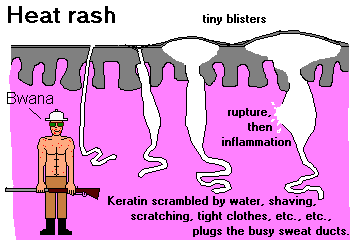
{12184} miliaria
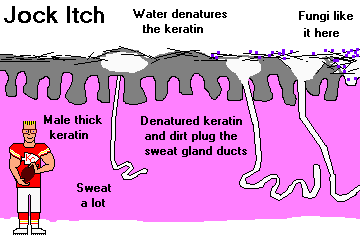
Maceration: Wet keratin eventually tends to break down, destroying its protective function. Mild cases in body creases become intertrigo, which can get fungal or bacterial superinfection and so forth. The worst cases can lead to "jungle foot", etc.
SUNLIGHT AND THE SKIN (Postgrad. Med. 89(8): 59, June 1991; Am. Fam. Phys. 50: 32, 1994)
You do not beg the sun for mercy.
-- Stilgar in "Dune Messiah"
Ultraviolet light is a mutagen for DNA and also makes melanocytes undergo mitosis (promotion):
Long-wave (UVA) 320-400 nm
"Black light"; tanning beds, gives the best day-glow colors; 320- 340 may burn you; some carcinogenic effect
Medium-wave (UVB) 290-320 nm
Sunburn spectrum, vitamin D activation, stronger carcinogenic effect, photoaging (* worst wavelength for burning is 297)
Short-wave (UVC) 200-290 nm
Damages nucleic acid more severely than UVB; peak nucleic acid absorption and damage is 260 nm (* "germicidal UV is 254); not much of this in sunlight.
Melanin absorbs all of these wavelengths, and a suntan should help, also. Empirically, melanin and suntan protect from sunburn, but you must be very dark all the time to expect much protection from skin cancer, and the worst photoaging is in white folks who've had suntans most of their lives.
Nobody really knows the chemistry of sun damage (ultraviolet, "actinic" damage) to the skin, but it's impressive. The lighter your skin, the more ultraviolet exposure you get from an afternoon at the beach.
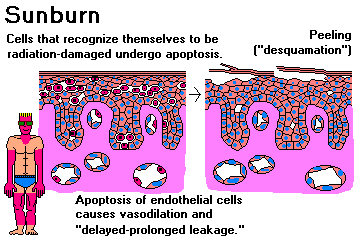
If you biopsy your acute sunburn, you'll see individual cell apoptosis in the deeper epidermis ("sunburn cells"; their DNA was injured and their p53 has directed apoptosis), as well as edema in the upper dermis (the red, of course, is hyperemia).
* Nicotinamide seems to prevent skin damage from ultraviolet in those at high risk for skin cancer, and decrease the rate of new non-melanoma skin cancers (NEJM 373: 1618, 2015.)
| In skin exposed to heavy sunlight for long periods of time ("weather-beaten", "photo-aged"), the upper layer of the dermis exhibits a poorly-understood change in its fibers and ground-substance. Pale basophilic material that stains like elastin is deposited (SOLAR ELASTOSIS), causing the skin to become deeply furrowed. It's now clear that much of the problem is greatly decreased type I collagen synthesis, and that tretinoin (retinoic acid) works by restimulating this synthesis (NEJM 329: 530, 1994; * metalloproteinase induced by ultraviolet and blocked by retinoic acid NEJM 337: 1419, 1997). |  Clint Eastwood's first career was military swimming instructor |
In diseases in which there is defective DNA repair (i.e., the xeroderma pigmentosa family), patients suffer photomutilation and many cancers of the skin.
In diseases in which sunlight falling on abnormal porphyrins results in extra free radical generation (i.e., porphyria cutanea tarda and its more vicious kin), the skin is heavily damaged by sunlight, though tumorigenesis isn't a prominent feature. (This makes sense -- the porphyrins in a cell are in the mitochondria and cytoplasm, while the DNA is in the nucleus.)
Healthy people who are exposed to lots of sunlight (tanning beds, etc.,) without good sun-screens are also asking for skin cancers. These include the four major lesions: actinic ("solar") keratosis (carcinoma in situ of the epidermis), squamous cell carcinoma (cancer proper of the epidermis), basal cell carcinoma (actually cancer of hair), and malignant melanoma ("black mole" cancer of melanocytes). Sun-induced skin changes and tumors: Prim. Care. Clin. Off. Pract. 27: 435, 2000.
Fortunately, the "healthy tan" is becoming unfashionable as the public learns more about the dangers of sunning. This is a not-so-rare tribute to the intelligence of the U.S. public, or at least the ease with which we become frightened (in this case, appropriately; one wonders whether the public is more afraid of cancers or wrinkles). Teens and tanning beds: Arch. Ped. Adol. Med. 157: 854, 2003; Texans and tanning beds: South. Med. J. 96: 652, 2003.
Likewise, the Montreal and ensuing protocols for the control of chlorofluorocarbons that deplete the ozone layer is a rare triumph of good science and good public policy over economic greed. Thankfully, the world recognized the need, saving the lives of many people, especially poor folks who work outdoors. Since skin cancer has a long latency, the benefits won't appear for a long time. This is one that the environmentalists got right, and because the risk is real and the cost is reasonable, the politicians went along.
Again, remember that tanning doesn't protect you enough from the really bad carcinogenic rays, though it offers fair protection from sunburn.
NORMAL AGING
The epidermis thins (thin epidermis becomes shiny and wrinkles), the dermis thins (thin dermis looks and feels thin), and the skin loses its elasticity (and this helps the wrinkling process).
A variety of minor pigmented lesions (large lentigines, cherry angiomas, and seborrheic keratosis) often crop up.
* Chemistry of aging and photoaging: Arch. Derm. 138: 1462, 2002.
{25015} senile atrophy of the skin
ICHTHYOSIS
The X-linked recessive form is caused by lack of steroid sulfatase (formerly "arylsulfatase C"), which is responsible for the breakdown of the cholesteryl sulfate glue that helps hold skin cells together.
* If for some reason you want to distinguish these two entities, the autosomal dominant form spares the flexural creases, while the X-linked recessive form involves them. We can tell on biopsy too.
The more severe LAMELLAR ICHTHYOSIS is a mix of genetic diseases, including people with defective K1 or K10 keratins, and people with defective transglutaminases (Proc. Nat. Acad. Sci. 95: 687, 1998). The skin is red, scaly, and blistery. The most severe variant is harlequin ichthyosis (after the character in the lozenge-covered tights), caused by a mutated lipid transporter ABCA12 (Arch. Derm. 142: 914, 2006.)
|
|
|
VITILIGO
An autoimmune process in which melanocytes disappear over sharply-circumscribed patches.
The patient develops white, non-tanning, geographic spots.
Some vitiligo is familial. Occasionally, vitiligo heralds the appearance of malignant melanoma elsewhere in the body; in this case, we assume that the immune system has become angry with all melanocytes and chooses various battlefields.
More often, vitiligo runs with some other autoimmune disease, notably autoimmune addisonism and/or autoimmune atrophic gastritis.
Most often, however, vitiligo occurs alone.
The process tends to spread, and it will tend to pop up at sites of injury (the "Koebner phenomenon", more famous in psoriatic patients).
Vitiligo affects 1% of humankind. Many patients hate it (respect this), but more than a few enjoy it.
In light-skinned folks, vitiligo may only be visible when the person tans, or is examined under ultraviolet light ("Woods lamp"; keep it handy, too, to spot ash-leaf spots and tinea versicolor). In dark-skinned folks, the disease self-cures when the entire body is affected.
{12183} vitiligo
{12474} vitiligo
{12489} vitiligo
* Future physicians: Topical steroids help some. Some patients who have residual melanocytes in the skin benefit from "PUVA" (psoralen plus ultraviolet) therapy. (I'd refuse this for vitiligo.) There are reports of good repigmentation using topical tacrolimus (Arch. Derm. 139: 581, 2003; Br. J. Derm. 153: 498, 2005). Also watch topical calcipotriol. And a variety of grafting procedures are now available for those who can afford them (Arch. Derm. 143: 643, 2007.) Update J. Am. Acad. Derm. 59: 713, 2008. Afamelanotide plus UV gives dramatic results JAMA dermatology 149: 63, 2013.
* There are several hereditary and acquired diseases featuring localized loss of melanocytes, from white patches in the hair (which may mean anything from nothing to Waardenburg's, a homeobox mutation) to the curious "piebaldism", a tyrosine kinase mutation syndrome (KIT proto-oncogene, codes for a mast cell receptor) in humans and animals (Am. J. Hum. Genet. 51: 1058, 1992). Don't confuse any of these with albinism, in which the melanocytes are present but never worked properly.
|  |
* Quite a few folks get IDIOPATHIC GUTTATE HYPOMELANOSIS on the lower legs and/or elsewhere as they get older; the etiology is unknown. In dark-pigmented people it can be quite impressive. The melanocytes in this kind of lesion lack good dendrites.
URTICARIA ("hives"; Am. Fam. Phys. 83: 1078, 2011)
The result of mast cells degranulating in the skin, immunologically or non-immunologically.
You're already familiar with this lesion when caused by type I immune injury. Vessels dilate and leak in the dermis, typically because histamine has been released here. The "wheal" of edema and the "flare" of dilated vessels are very familiar. If you are foolish enough to biopsy it, eosinophils are usually abundant because of the chemotactic mast-cell factors.
Cold urticaria patients have mast cells that degranulate too easily in the cold. ("I'm allergic to the cold!" "I'm allergic to popsicles." This isn't trivial when a person needs hypothermia for cardiac bypass Ann. Thor. Surg. 89: 949, 2010). Some people get non-IgE dependent urticaria from sun, exercise, opiates, prostaglandin inhibitors (why?), or type III immune injury.
Many redheads have dermatographism (i.e., urticaria develops on slight pressure. In dermatographism, the "hives" are likely to be linear.
 Dermatographism
My red-haired colleague Ron Irick
also gets linear urticaria
Many redheads and some non-redheads develop chronic urticaria. Usually you'll never find the cause, but you can try an elimination diet for starters. Autoantibodies against IgE receptors account for an unknown percent of cases. We await easy tests for autoantibodies against mast cells and their surface components. Update Postgrad. Med. 122: 148, 2010.
{09716} urticaria
{09717} urticaria
{09720} urticaria
{12241} dermographism
Angioedema is urticaria that extends down into the subcutaneous fat. You remember that if you lack C1 esterase inhibitor, you'll suffer episodes of angioedema.
THE ECZEMA FAMILY (Postgrad. Med. 89(8): 75, June 1991)
|
|
Acute-type inflammation of the epidermis. The many members of this family all present as red (hyperemia in the dermis), oozy (i.e., the epidermis is gone in places), crusty (i.e., some protein from spongiosis fluid has dried on the surface) papules (i.e., there's no extra tissue) and vesicles (i.e., there is spongiosis/edema separating some of the epidermal cells).
With time, the lesions stop oozing and instead become elevated and scaly (i.e., protective hyperplasia, with acanthosis and hyperkeratosis). At this stage, the more you scratch, the worse your lesion gets.
LICHEN SIMPLEX CHRONICUS, from chronic inflammation and/or scratching, features long, regular rete pegs with orthokeratosis and a thick granular layer (in contrast to psoriasis). The dermal papillae are likely to contain prominent collagen bands perpendicular to the surface (why?)
* EOSINOPHILIC SPONGIOSIS looks like eczema, but is rich in eosinophils. Eczema in allergic folks, spider bites, and a few obscure diseases produce this patern.
{12298} lichen simplex chronicus
{13114} lichen simplex chronicus
CONTACT DERMATITIS
Most often this results from type IV immune injury, the injurious agent is a hapten, and of course the presenting cell is the Langerhans cell. It doesn't help if there's also exposure to some irritant.
Contact dermatitis itches bad and looks bad. Worldly-wise dermatologists can tell the offending agent by the location on the patient. Ask one about "patch tests" to pinpoint the bad chemical.
Outbreaks happen from time to time. A shoe factory in Argentina adds a new chemical to its leather treatment system: Clin. Tox. 49: 508, 2011. The rove beetle among our troops in Afghanistan: Mil. Med. 169: 57, 2004. Little venomous blister-beetles in a Chinese sweatshop (Paederus dermatitis): Int. J. Derm. 48: 128, 2009. An entire boy scout camp gets dermatitis from caterpillars: J. Am. Acad. Derm. 56: 952, 2007.
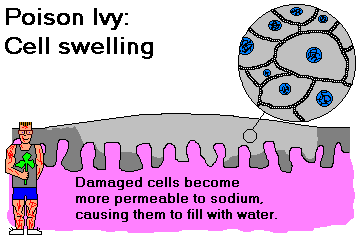
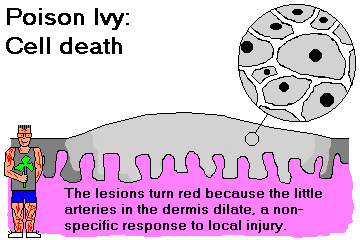
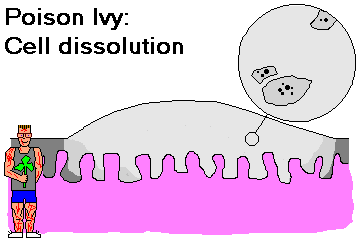
Poison ivy ("urushiol-induced contact dermatitis") requires no description; if the patient "isn't sure", look for little blisters in lines where the leaves brushed across the skin.
 Botanical dermatology
Some fascinating pictures
of plants and people
ATOPIC DERMATITIS (NEJM 358: 1483, 2008 is beautifully illustrated and shows the continued mystery of this common illness)
Eczema, typically in the flexural creases of elbows and knees, typically in kids (about 1 in six is affected to some degree) is widely believed to be food allergy (nobody knows how; ask about personal or family history of hay fever, food allergy, or asthma).
* The account of the immune system changes in these people has become tremendously complex, almost as bewildering as psoriasis (J. Allerg. Clin. Imm. 127: 1110 & 1420, 2011).
The best treatment is supposed to be an elimination diet, but very few people are going to comply with this. Topical glucocorticoids keep most cases under control, but if the disease is extensive, they can be absorbed systemically and make the child sick.
* Staph
superantigen toxins seem to make this worse, but only about half
of children are infected. Stay tuned: J. Allerg. Clin. Imm. 105: 814, 2000.
I predicted the success of topical therapy with macrolactams (tacrolimus family) during the 1990's; it is now mainstream (JAMA 285: 724, 2001).
Today, dupilumab (an antibody that blocks interleukin-4 and interleukin-13) seems to be highly effective (NEJM 371: 130, 2013).
PHYTODERMATITIS ("fruit mask", "Club Med" dermatitis) results from the photosensitizing effects of psoralens (furocoumarins) from plants (limes, lemons and celery are notorious) on the skin. The term may also include allergic or toxic reactions to a variety of plants and their fluids.
DRUG RASHES
Biopsy a common drug rash and it may turn out to be:
{08161} "eczema"
{12498} "eczema"
{24990} "eczema"
{12523} eczema secondary to photodermatitis
{12293} atopic dermatitis
{12294} atopic dermatitis
{12531} atopic dermatitis
{12534} atopic dermatitis, lichenified
{08160} contact dermatitis, hat band
{25581} she was allergic to her tincture of benzoin
{19349} contact dermatitis, earring
{12127} contact dermatitis
{12538} contact dermatitis, weepy
{12542} contact dermatitis, metal hapten
{12544} contact dermatitis, shoe
{12546} contact dermatitis, spray-on deodorant
{19358} contact dermatitis, balloon cells
{08154} poison ivy
{12562} nummular dermatitis

ERYTHEMA MULTIFORME ("EM"; Am. Fam. Phys. 46: 1171, 1992; Postgrad. Med. 107: 87, 2000)
A very important illness. It's self-limited if the cause can be found and eliminated, or may vanish on its own; or it may hang around as a lifelong nuisance. Not everyone will agree with "Big Robbins'" claiming that this is "uncommon"; before managed care, around 1 hospital admission in 300 was to work out erythema multiforme quickly; see Arch. Derm. 126: 43, 1990).
The common denominator of "EM" is that the T8+ cytolytic (T-CTL) lymphocytes become angry with the epidermis and the dermal blood vessels.
A person may develop "EM" as a result of
1. Herpes simplex
(it's in the lesions themselves: Pediatrics 89: 32, 1992)
2. Any serious infection that activates the chronic inflammatory cells
(leprosy,
deep fungi,
mycoplasma -- if Stevens-Johnson doesn't follow a new medication, it's likely after mycoplasma Pediatrics 127: e1605, 2011)
3. Drug rash (allopurinol, penicillins, sulfa drugs including "Septra/Bactrim", phenytoin, barbiturates, the old anti-inflammatory phenylbutazone, many others -- we may soon be screening everyone we start on carbamazepine for hLA-B*1502 JAMA Derm 149: 1025, 2013)
4. Paraneoplastic (especially lymphomas, but any cancer can do it)
5. Lupus / polyarteritis / dermatomyositis.
6. Or the darned thing may be idiopathic, and keep coming and going throughout your life.
As the name implies, the lesions can have many different gross appearances. Most famous is the "target lesion" ("iris lesion"; the pale center is necrotic, the red surrounding region is inflamed).
Most erythema multiforme is "minor", sparing the mucosal surfaces. "Major" actually means it involves the mucosa, but you may also hear it used especially for Stevens-Johnson, which some folks consider a separate illness. The STEVENS-JOHNSON SYNDROME (Arch. Dis. Child. 98: 998, 2013), a serious febrile systemic illness with purpura and involvement of the mucosal surfaces. (* A few dermatologists distinguish "severe erythema multiforme" and SJS based on how the patient looks clinically, but the pathology is about the same: Arch. Derm. 138: 1019, 2002).
Microscopically, the lesions exhibit lymphocytes attacking epidermis and vessels.
{09698} erythema multiforme
{09699} erythema multiforme
{09701} erythema multiforme
{09702} erythema multiforme
{09704} erythema multiforme
{09705} erythema multiforme
{12261} erythema multiforme
{12516} erythema multiforme, vesicular
{12126}erythema multiforme bullosum
{12529} erythema multiforme, purpuric
{09710} bad erythema multiforme
{05943} Stevens-Johnson syndrome, skin
{05944} Stevens-Johnson syndrome, oral ("cheilitis")
{10304} toxic epidermal necrolysis
{09711} toxic epidermal necrolysis
{09713} toxic epidermal necrolysis
 Pustular dermatitis
Prize photograph
Institute of Medical Illustrators
TOXIC EPIDERMAL NECROLYSIS is a dermatological emergency with full-thickness necrosis of 30% or more of the epidermis.
Early lesions show vacuolization and necrosis of the basal layer.
Soon the entire epidermis has undergone
coagulation necrosis.
In "classic toxic epidermal necrolysis", there is little inflammation microscopically. However, there's probably a continuum between this and Stevens-Johnson.
As you would expect, the epidermis blisters and sloughs; separation is at the dermal-epidermal junction.
* Both toxic epidermal necrolysis and Stevens-Johnson are treated by admission to the burn unit and supportive care. Suggested specific treatments, including the various immunosuppressive agents that have been tried, haven't been very helpful (Crit. Care Med. 39: 1521, 2011).
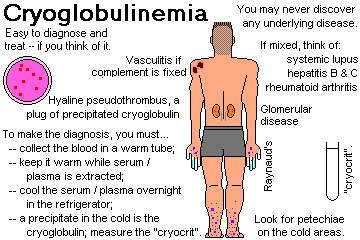
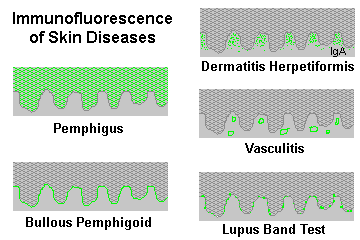
LEUKOCYTOCLASTIC VASCULITIS invites contrast with erythema mutiforme. This is a vasculitis (usually type III immune injury) in which dead polys surround hurt-or-dying vessels (i.e., you see fibrinoid) in the dermis. The usual cause is taking medication; less often, cryoglobulinemia or vasculitis (famous Henoch-Schonlein or small-vessel polyarteritis).
Remember that if you see purpura and can also feel it, it's very likely that there's a vasculitis. Don't ignore it... you don't want gangrene next.
{13313} leukocytoclastic vasculitis
{12259} leukocytoclastic vasculitis, palpable purpura
UNDER THE DERMIS
|
|
Fat suffers few diseases. "Panniculitis" is inflammation of the fat under the dermis. These tend to be self-limited and self-healing, but are uncomfortable and unsightly lesions.
ERYTHEMA NODOSUM presents as tender red bumps on the shins. If you biopsy it, you'll see fibrosis of the septa of the fatty panniculus, with a mixed inflammatory infiltration.
The pathophysiology is unknown. Notable causes include any disease the chronic inflammatory cell
systems (deep infections, TB,
leprosy,
coccidioidomycosis, Behcet's, rheumatic fever, ulcerative colitis, Crohn's, cancer), or oral
contractive pills or sulfa drugs. Most cases
follow a strep
throat infection or are
"idiopathic". Most cases resolve spontaneously after a
few weeks.
{12484} erythema nodosum
* ERYTHEMA INDURATUM resembles erythema nodosum, but is less intense, more granulomatous, more vasculitic, and more prone to undergo necrosis and to ulcerate. It is usually idiopathic.
WEBER-CHRISTIAN is a serious pediatric panniculitis. Leave the diagnosis to us.
GRANULOMA ANNULARE features collagen with dead fibroblasts surrounded by a ring ("annulare") of granulomas. Under the microscope, there's mucin in the center and the histiocytes in the granuloma form palisades.
* NECROBIOSIS LIPOIDICA, depressed yellow spots most often on the shins of diabetics, shows alternating layers of very dense collagen and a dense plasma-cell and histiocyte infiltrate.
* CHILBLAINS is a poorly-understood process that must involve excessive reactivity of the vessels to cold and/or a cryoglobulin. Feet and ankles exposed to the cold develop painful purple areas (ischemic damage). These resolve spontaneously. Read about it: J. Am. Acad. Derm. 23: 257, 1990; Med. J. Aust. 154: 406, 1991.
PYODERMA GANGRENOSUM is full-thickness necrosis of a patch of skin, with masses of neutrophils in the dermis coalescing until an abscess appears. Clinicians describe a blue overhanging border. The cause and pathophysiology remain elusive. Look for it in ulcerative colitis, diabetes, or by itself.
PSORIASIS (Madison Avenue's "heartbreak", etc.; Lancet 361: 1197, 2003; Lancet 370: 263, 2007)
A common, usually banal, exacerbating-and-remitting, mysterious (polygenic and immune) illness generally arising in young adult life, affecting maybe one person in 50.
Nobody knows the cause (* ask whether the patient is taking lithium or quinidine), but one distinctive feature is rapid cell turnover in the epidermis. An epidermal cell ordinarily lives about a month before it's shed; in psoriasis, its life is shortened to three days or so.
The pathogenesis remains obscure. There is no animal model (J. Clin. Inv. 116: 2084, 2006). T-cells in the upper dermis produce cytokines that cause the excessive proliferation of epithelial cells. T-17 helper cells are the abundant cell in the lesions -- watch this. A new T-cell subset is discovered in psoriatic lesions: J. Imm. 187: 2783, 2011. What's known: NEJM 361: 496, 2009.
* Beyond this, you'll go crazy if you try to keep track of the various intercellular adhesion molecules, immune disturbances, and so forth, in various stages of psoriasis (Arch. Path. Lab. Med. 127: 178, 2003; J. Clin. Inv. 113: 1664, 2004, others) others). Efalizumab for psoriasis: Arch. Derm. 141: 31, 2005 (banned in 2009 after a handful of progressive multifocal leukoencephalopathy cases). Infliximab for psoriasis: Arch. Derm. 138: 644, 2002; Lancet 366: 1367, 2005. Etanercept is now the most popular with physicians and patients: Arch. Derm. 143: 846, 2007; triumph NEJM 358: 241, 2008). Ustekinumab, an antibody against interleukin-12/23, for psoriasis triumphed in two major studies: Lancet 371: 1665 & 1675, 2008 -- and now is proving superior to etanercept (NEJM 362: 118, 2010). Brodalumab, the anti-interleukin-17-receptor antibody: NEJM 366: 1181, 2012. Ixekizumab, the anti-interleukin-17 antibody: NEJM 366: 1190, 2012. Briakinumab (antibody against interleukin-12/23): NEJM 365: 1586, 2011. Brodalumab, the anti-IL17RA antibody: NEJM 370: 2295, 2014. Secukinumab, another anti-IL17A antagonist: NEJM 371: 326, 2014. However, in some people treated for other causes, we are now seeing spectacularly severe cases of psoriasis erupt following initiation of anti-tumor necrosis factor therapies (Arth. Rheum. 52: 2513, 2005.)
Most people are familiar with the sharply-demarcated salmon-pink, silver-scaled psoriasis plaques. Look especially on the elbows.
If you pick off the scales, you'll see multiple punctate bleeding points ("Auspitz's sign"). These are, of course, the tips of the dermal papillae.
The histology is distinctive. Look for:
There are a variety of other common findings in, and variations on, psoriasis.
Nail changes range from pitting and/or discoloration to crumbling.
Koebner's phenomenon is common in psoriasis, with lesions popping up wherever the skin is scratched or otherwise damaged. (* Idea: Activation of genes, production of cytokines that keep one another going, and all that. Maybe both psoriasis and morphea are exaggerations of processes that normally occur in healing.)
Psoriatic arthritis is usually mild, but can produce serious deformity. HLA-B27 positive patients are prone to get ankylosing spondylitis, etc., etc.
Total-body confluent plaques of psoriasis is one cause of erythroderma (the other common identifiable cause is Sezary's / mycosis fungoides). People consider and even commit suicide over this sort of thing (Br. J. Derm. 139: 846, 1998).
Scaly patches on the scalp can be psoriasis, seborrhea, or something in-between ("seborrhiasis").
* AIDS patients are prone to vicious psoriasis. Like almost everything else about psoriasis, this is mysterious.
* A team in Iceland found that psoriasis improved in the vast majority of patients after removal of the tonsils, which is where weird-keratin and T-cells interact: J. Imm. 188: 5160, 2012.
{12264} psoriasis
{12574} psoriasis
{12576} psoriasis
{12579} psoriasis
{12580} psoriasis
{12582} psoriasis
{12585} psoriasis
{19367} psoriasis
{19370} psoriasis
{19385} psoriasis
{24875} psoriasis
{12475} psoriasis, Koebner phenomenon
{12513} exfoliative erythroderma, maybe psoriasis, maybe mycosis fungoides, maybe who-knows?
|
|
* Everybody knows about the various older remedies for psoriasis. In the 1990's, the big news was the vitamin D analogue calcipotriene (Mayo Clin. Proc. 68: 835, 1993). Topical calcitriol ointment: Medical Letter 51: 70, 2009.
LICHEN PLANUS (Am. Fam. Phys. 61: 3319, 2000; NEJM 366: 723, 2012)
Another mysterious illness. This time, the T-cells seem to be attacking the basal layer.
In contrast to psoriasis, the cell turnover rate is slower than normal.
Physical diagnosticians describe "patches of purple, pruritic, polygonal papules". Good places to look are the glans penis, the flexor surfaces of the wrist and the inner surface of the mouth. In the last location, it will present as a distinctive white filigree of lines.
Microscopically, you'll see hyperkeratosis (probably not parakeratosis), a thick granular layer, a band-like infiltrate of lymphocytes in the upper dermis (hence the purple), conspicuously attacking the basal cells, which usually show hydropic change ("vacuolized"). This also transforms the rete pegs to a sawtooth pattern.
Apoptotic basal cells (* "Civatte bodies" / * "colloid bodies") tend to drop into the dermis or may remain in the epidermis.
{12280} lichen planus
{12476} lichen planus
{12591} lichen planus
{12592} lichen planus
{12597} lichen planus
{12600} lichen planus
{12601} lichen planus
{12591} lichen planus
{12604} lichen planus, filigree lesions in mouth
|
|
LICHEN SCLEROSUS ET ATROPHICUS
A mild, chronic, idiopathic lesion featuring a sharply-circumscribed, hypopigmented plaque on the bottom, typically extending around the genitals (especially on a man's glans) and anus and perhaps up the intergluteal cleft.
Under the microscope, you'll see edema and loss of structure of the normal collagen fibers in the upper dermis.
The lesion can appear at any age. As you would expect, it gets misdiagnosed as "proof of sexual abuse" in children (Am. J. Dis. Child. 145: 1058, 1991).
Management is difficult. Most recently, topical glucocorticoids are reported to work better than topical sex steroids. There's talk of laser treatment, which seems a little extreme.
{12188} lichen sclerosus et atrophicus
{24988} lichen sclerosus et atrophicus
* There once was a man from Antarctica
-- Author fortunately unknown! You'll hear this limerick frequently in the clinic.
Who had balanitis xerotica;
His wife had kraurosis
And lichen sclerosus
So neither of them got any erotica!
DISCOID LUPUS: Very common
You remember that patients with systemic lupus may get a butterfly rash and/or a discoid rash. Or someone may have the discoid rash, and not have systemic lupus. (The situations are about equally common.)
The discoid rash consists of sharply-circumscribed, scaly (hyperkeratotic), shiny (thin epidermis), depigmented (maybe hyperpigmented at the edges), at least semi-bald, red patches that are exacerbated by sunlight.
Histologically, discoid rash is distinctive. You will see:
No one knows the cause of discoid lupus, but the fact that it seems to respond to efalizumab, the anti-CD11a anti-T-cell agent (Arch. Derm. 143: 873, 2007) supports the idea that this is, like systemic lupus, a "mysterious immune problem."
if you stain for skin of a discoid or systemic lupus patient for IgG or complement, you'll often see granules along the dermal-epidermal junction ("a positive lupus band test").
{12273} discoid lupus
{25674} discoid lupus
{25676} discoid lupus
{12324} alopecia secondary to discoid lupus
ACNE VULGARIS (Lancet 379: 361, 2012)
If you never had any acne, you probably weren't a teen. Many men keep some until old age. Terms:
Comedone: A solid mass of sebum and keratin from a problem follicle
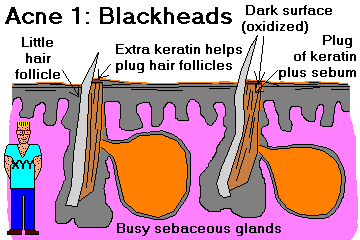
Open comedone: The familiar blackhead. The black on the surface is oxidized lipid from exposure to the atmosphere.
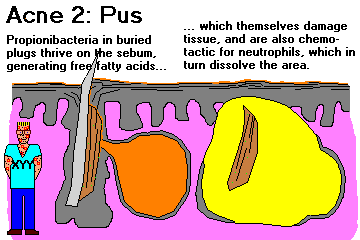
Closed comedone: The familiar plug buried under the epidermis, out-of-contact with air. Squeeze it before the follicle ruptures, and you'll get the familiar "filament". When the follicle ruptures, inflammation is likely, producing the familiar ripe whitehead; you'll find the plug when you squeeze the pus.
Propionibacterium acnes: A diphtheroid bacillus that enjoys cleaving the triglycerides in sebum into irritating fatty acids.
When you hit puberty, your sebaceous glands undergo hyperplasia in response to androgens, and the dead keratin layer on your epidermis thickens in response to androgens. Young men get both effects more than do young women. Keratin plugs follicles, more keratin accumulates in plugged follicles. Eventually the bacterium becomes involved, and the fatty acids produced by its metabolism generate much of the inflammatory response. The neutrophils enter; in severe cases ("cystic acne"; "conglobate acne", etc.) they leave the familiar craters (formerly much more common than they are today).
* Acne is always manageable today by scientific means; if topical benzoyl peroxide has not cleared Junior in two weeks, it's time for prescription-strength medication. Acne on the trunk usually requires systemic treatment. The oral contraceptive pill (for women who can take it) often clears acne. Don't use an antibiotic as sytemic treatment. Isotretinoin isn't for the faint-hearted but is remarkably effective. Curiously, many parents are very reluctant to allow their kids' acne to be treated scientifically, which surprises me.
Ways to make acne flare include taking extra androgens (i.e., at the gym), taking glucocorticoids, iodine (for your sporotrichosis, perhaps), or bromide (ancient sedative), or cyclosporine (Arch. Derm. 145: 797, 2009).
CHLORACNE, more and bigger blackheads than you thought possible, results from exposure to 2,3,7,8-tetrachlorodibenzodioxin. This is the contaminant in agent orange that caused all the hoopla (today's greens simply call it "dioxin" which generates all kinds of confusion with the minimally-toxic industrial solvenet); it caused chloracne and some teeth defects in babies when it was released at the Seveso plant in Italy, and it was used to poison and disfigure Victor Yushchenko when he was running for president of the Ukraine.
ACNE MECHANICA mostly results from sports (less often, physical work) where the clothes rub and the follicles end up occluded.
"Controlled studies showing no link between eating chocolate and getting acne" (two from the late sixties, uh, sure) surprised this former teen. Acne isn't the result of not washing.
As long as there's an adult level of androgen on board, acne-types can't expect a cure. Temporary relief comes from killing off the propionibacterium (tetracycline or various other antibiotics work wonders), making the sebaceous glands go away (various vitamin A compounds, systemic or topical -- how the sebaceous gland cells undergo apoptosis J. Clin. Inv. 118: 1468, 2008), and removing the dead keratin layer from the skin (ineffective enough to be available over-the-counter).
* Serious acne scarring still occurs, although with today's medicines it's almost completely preventable. Scars may be rounded, depressed, hypertrophic, and/or "icepick" depending on how they healed. If the person does not like it, there are a variety of ways of treating it (J. Am. Acad. Derm. 59: 659, 2008); most popular is laser resurfacing.
A quacky laser-therapy for acute acne fails utterly: JAMA 292: 2834, 2004.
If there's no comedones, it's not acne.
Very severe acne involving the armpits as well is probably hidradenitis suppurativa.
|
|
{09722} acne
{09725} acne
{12144} acne
{12145} acne
{24919} acne, face; your lecturer age 13
{24981} acne, blackhead city
{12495} acne, closed and open comedones
{12148} acne, open comedone, world's largest blackhead
{12221} acne, open comedone, world's second largest blackhead
{25672} histology of the comedone!
{25673} histology of the comedone!
* ACNE FULMINANS: type III immune injury involving propionobacteria. Nasty. See Br. Med. J. 308: 833, 1994.
ROSACEA (formerly miscalled "acne rosacea") is a poorly-understood illness, in which reddening and discomfort over the malar areas may look like the butterfly of lupus and dermatomyositis, or if pustules are present mimic acne vulgaris. Topical metronidazole helps for rosacea. Some exotic molecular players are being described (Nat. Med. 13: 975, 2007; Postgrad. Med. 121: 178, 2009).
{12149} acne rosacea
{09728} acne rosacea
* Although no bacterium has been implicated, tetracycline is an empirical remedy.
Rhinophyma ("W.C. Fields' nose", Shakespeare's Bardolph), supposedly a variant of acne rosacea, involves hyperplasia of sebaceous glands, notably on the nose. There can be a conjunctivitis too. Again, the process is mysterious.
PEMPHIGUS VULGARIS (Lancet 354: 667, 1999) and the other blistering disorders
Pemphigus vulgaris is autoimmune destruction of the desmosomes of stratified squamous epithelium. A serious, potentially-lethal blistering disease. We don't know all the steps, but eventually the epidermal cells cease to stick to one another.
The autoantigen is usually desmoglein 3, a cadherin ("calcium-dependent adhesion molecule"), and the epitope has been found at the sticky spot (J. Clin. Invest. 102: 775, 1998); antibodies against desmoglein 1 may also be present. The antibodies are very well-characterized (Am. J. Path. 178: 718, 2011).
Patients are tormented by blistering on the skin and mucosal surfaces. Nikolsky's sign is the appearance of a blister on minor rubbing of the skin. Eventually much of the skin may become lost and/or infected, and death can result.
Histologically, you'll see impressive acantholysis, worst immediately above the basal layer. The top of the blister is where the dead cells are stuck together. Look for the familiar "tombstones", basal cells remaining attached to the basement membrane as all other epidermal cells separate from one another; i.e., the blister is caused by "suprabasal acantholysis". In pemphigus and the other major blistering diseases, the keratin is normal.
Immunofluorescence stain, of course, shows IgG between the cells of the epidermis, though not along the basement membrane.
Intravenous immunoglobulin has worked wonders for these people. Rituximab: Arch. Derm. 148: 734, 2012 (mixed results), JAMA Derm 150: 703, 2014 (great preliminary results).
{12123} pemphigus vulgaris
{12124} pemphigus vulgaris
{12651} pemphigus vulgaris
{12657} pemphigus vulgaris
{12658} pemphigus vulgaris
* Pemphigus foliaceus, a group of several diseases being sorted out, generally has antobidies mostly against desmoglein 1. In the US, it is mostly a sporadic disease of older folks, and may transition to and from pemphigus vulgaris. The granular layer, rather than the spiny layer, takes the worst damage.
Big review: NEJM 343: 23, 2000; update on the molecular biology J. Clin. Inv. 115: 3157, 2005. A variant with abundant antibodies against both desmogleins: Arch. Derm. 143: 895, 2007.
* Anti-desmoglein 3 antibodies arise in pemphigus by somatic mutations of the lymphocytes that produce them. J. Clin. Inv. 122: 3781, 2012.
Paraneoplastic pemphigus involves yet a different autoantibody (anti-desmoplakin). triggered by "tumor immunity" (small comfort). Review of autoimmunity against desmosomes and hemidesmosomes: Clin. Exp. Immunol. 107 S-1: 9, 1997. It can also involve the lungs, with lethal effect: Arch. Derm. 137: 193, 2001; J. Immuno 191: 83, 2013.. Update Arch. Derm. 148: 1165, 2012.
* Hailey-Hailey benign familial pemphigus is an autosomal dominant disease. It is a groin-and-armpit problem. The histopathology is a "dilapidated brick wall". The gene is ATC2C1, an epidermis calcium pump: Nat. Genet. 24: 61, 2000.
* Rituximab for both pemphigus vulgaris and pemphigus foliaceous: Arch. Derm. 143: 1033, 2007; update on the success of rituximab for pemphigus Arch. Derm. 148: 734, 2012.
(BULLOUS) PEMPHIGOID (Lancet 381: 320, 2013)
Another autoimmune, blistering disease, milder than pemphigus, with negative Nikolsky's sign. It may be localized or generalized, often involves the mucous membranes. In bullous pemphigoid, the attachment of basal cells to the basement membrane is selectively damaged. As you would expect, blisters are "subepidermal" and "non-acantholytic". Immunofluorescence shows a linear (not granular, as in lupus) deposit of immunoglobulin and complement along the basement membrane.
The autoantigen is a hemidesmosome collagen (J. Clin. Invest. 87: 734, 1991; J. Imm. 145: 3728, 1990, collagen XVII / BPAG2).
* Topical glucocorticoids are usually enough. Mild disease may respond to nicotinamide plus tetracycline, an innocuous regimen (Arch. Derm. 130: 753, 1994).
* Cicatricial (benign mucosal) pemphigoid involves either of at least two different antigens, and affects mucosal surfaces, most troublesome being eyes and larynx.
* Oral pemphigoid has a different autoantibody set (J. Imm. 176: 1968, 2006).
* Pemphigois gestationis (formerly "herpes gestationis") is a similar, very itchy, thankfully rare disease seen in pregnancy. The placenta triggers production of an antibody that cross-reacts with the basal layer. Of course it has nothing to do with herpes virus. Baby can be affected. Update Arch. Derm. 143: 1168, 2007.
{12125} pemphigoid
{12633} pemphigoid
{12634} pemphigoid
{12636} pemphigoid
{12637} pemphigoid
{12640} pemphigoid
{12643} pemphigoid, histology
{12644} pemphigoid, immunofluorescence (yellow)
{12694} cicatricial pemphigoid
* Misdiagnosis of bullous pemphigoid as "sexual abuse of a little girl": Arch. Derm. 128: 804, 1992.
COMMENT: It's terrible to miss true sexual abuse, and it's also terrible when a physician's or nurse's
arrogant ignorance traumatizes a family emotionally and economically.
Many people involved with child protection infallibility complexes, and you
cannot reason with them even when they are obviously wrong.
For much, much more on
this, see Md. Ec. March 8, 1993, p. 79 (chickenpox called
cigaret
burns, normal anatomic variants
illustrated in a child-abuse manual as "proof of sexual abuse", etc., etc.); also Pediatrics 91: 423,
1993. All-too-much of my own pro-bono work results from this kind of stupidity.
| POMPHOLYX ("dyshydrotic eczema") is a very common, banal, but annoying disease in which little blisters cover the palms and soles. A minor mystery of medicine, there's a link to nickel allergy (J. Derm. 19: 964, 1994; Cutis 47: 157, 1991), or other metal allergy, in people with sweaty palms. | 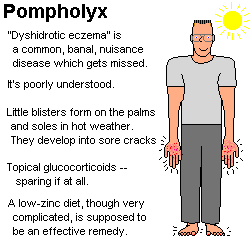
|
DERMATITIS HERPETIFORMIS
An autoimmune disease that still presents intriguing riddles. The essential problem seems to be autoantibodies against reticulin (!), which anchors the basement membrane to the dermis proper.
Patients come in with symmetric (right-left) patches of little vesicle clusters ("they remind me of the little groups of sore blisters in real herpes") and/or hives that itch bad. Look especially on elbows, knees, and buttocks.
If you don't recognize the lesion on clinical grounds and decide to biopsy it, you'll see (on H&E) masses of fibrin and groups of polys in the tips of the dermal papillae, and (on immunofluorescence) clumps of IgA at the tips of the dermal papillae. Blistering (if present) occurs underneath the epidermis and its basement membrane.
Almost all of these patients have at least subclinical gluten (gliadin) enteropathy, and if you want the dermatitis herpetiformis to go away, you need to prescribe a gluten-free diet.
And now you sit in your bathtub, testing the validity of the proposition, "The more you scratch, the more you itch."
|  Marat |
{12122} dermatitis herpetiformis
{12663} dermatitis herpetiformis
{12524} dermatitis herpetiformis, eczematized
{12672} dermatitis herpetiformis, immunofluorescence for IgA
|
|
EPIDERMOLYSIS BULLOSA
A family of subepidermal blistering diseases.
The acquired form is caused by autoantibodies against type VII collagen of the basement membrane (Arch. Derm. 128: 58, 1992). There are a host of congenital forms. They may involve inheritance of a defective form of type VII collagen, or a defective basal epidermal keratin (Proc. Nat. Acad. Derm. 90: 7414, 1993) or integrin (Nat. Genet. 13: 366 & 370, 1996; Am. J. Path. 152: 935, 1998), or overproduction of collagenase, or any of several other defects. There are several variants, recently reclassified (J. Am. Acad. Derm. 58: 931, 2008).
The worst hereditary form makes it impossible to safely handle the child without causing it severe pain.
Bone marrow transplantation for the most severe cases seems to help some, with the stem cells reconstituting some of the epidermis (NEJM 363: 629, 2010).
* Severe congenital epidermolysis bullosa is a frequent counter-example for "every child can have a good quality of life" fantasy ethics discussions: J. Med. Ethics 24: 200, 1998. Along with open neural tube defects, it became the centerpiece of the 2004 Groningen protocol for euthanasia of newborns in the Netherlands ("the Dutch cure").
* Update on the molecular biology of the subepidermal blistering diseases, both autoimmune and hereditary: Virchows Arch. 443: 184, 2003.
An epidermolysis bullosa patient with Lamin 5 deficiency gets relief from gene therapy: Nat. Med. 12: 1397, 2006.
WARTS ("verrucae")
Contagious, auto-inoculable, and sometimes serious. A few terms:
Flat wart ("plana"): Most anyplace. Prone to regress spontaneously; some people claim "suggestion" sometimes works.
Plantar wart: On the sole of the foot, and ground in deep
Condyloma acuminatum ("venereal wart"): At best, a cosmetic problem. At worst, a breeding-ground for cancer.
Bowenoid papulosis: carcinoma in-situ with a tendency to spontaneously regress, caused by HPV 16.
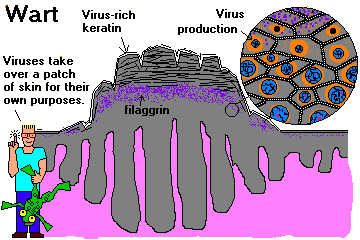
The gross appearance of the wart requires no description. You can appreciate the papillomatosis, especially if you peel off the surface keratin.
You remember that a DNA virus family (HPV) is responsible; common warts are HPV-2. Condyloma acuminatum is often HPV-6. The immunosuppressed may be covered with many, many warts.
Histologically, look for acanthosis, papillomatosis, and hyperkeratosis. Vacuolization (koilocytosis) of some cells produces perinuclear halos. Electron microscopy shows human papillomavirus in the nucleus.
{08203} warts
{12138} wart
{24894} wart
{08983} wart, histology
{08986} wart, histology
{12164} condyloma acuminata
|
|
|
|
|
Any man who knows his trade, does not fear ghosts, has read fifty good books, and practices the common decencies stands out as brilliantly as a wart on a bald head.
-- H.L. Mencken, 1922
MOLLUSCUM CONTAGIOSUM ("dimple warts")
A minor, self-curing, annoying disease caused by a pox-virus spread by touching.
Grossly, you'll see itchy little papules up to 4 mm (bigger in those who are perhaps extra vulnerable). The nodule has a central dimple, and when squeezed or scratched (and the virus knows you will squeeze or scratch it!), a chunk of cheese-like material comes out. This is pox-viruses eager to be spread on your hands to somewhere or someone else.
Microscopically, look for marked acanthosis forming a raised nodule. Infected cells produce an
intracytoplasmic molluscum body (pox virus inclusion) as they mature, and as they die, they deposit
the virus in the center.
There are a variety of Rx's that seem to work okay. Sodium nitrite with salicylic acid sounds good (Br. J. Derm. 141: 1051, 1999).
{08205} molluscum contagiosum
{12174} molluscum contagiosum
{12175} molluscum contagiosum
{24730} molluscum contagiosum
{24731} molluscum contagiosum
PITYRIASIS ROSEA (Am. Fam. Phys. 69: 87, 2004)
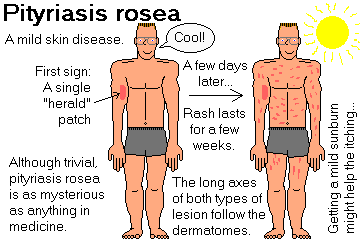
A relatively common disease, mostly of young adults. The etiology remains obscure; probably it is some virus or other.
The initial lesion is the "herald patch", a pink plaque with its long axis along a dermatome. After a while, this fades, only to be replaced by a widespread eruption of smaller plaques, with their long axes all oriented along the dermatomes, too.
* Hopefully nobody will biopsy it, but if you do, you'll see little bleeds in the papillae, and mounds of parakeratosis.
Nobody dies of this, but it itches like crazy for a few weeks. A mild sunburn is therapeutic.
Pityriasis rosea
Patient photo
Thanks Brian!
{12279} pityriasis rosea
{12487} pityriasis rosea
{12610} pityriasis rosea
{12616} pityriasis rosea
IMPETIGO
Bacterial infection of the epidermis, almost always
staphylococci
with or without help from
β-hemolytic streptococci
(the latter can give you glomerulonephritis just like a strep cellulitis can).
Grossly, dermatologists admire the honey-colored crusts (i.e., the usual dried-spongiosis fluid crust seen when epidermis and its basement membrane are damaged, plus honey-color from greenish-yellow dead neutrophils tinged with red cells).
The bacteria produce oozing (and thus access to nutrients) by damaging the desmoglein which holds the cells of the epidermis together.
Eczema and most other diseases involving breaks in the epidermis are prone to impetigenize, i.e., become secondarily infected with bacteria.
Impetigo is somewhat contagious. If you are foolish enough to biopsy impetigo, you'll see neutrophils just under the stratum corneum.
{24970} impetigo
{24971} impetigo
{24972} impetigo
{24973} impetigo
{12128} impetigo, bullous
|
|
NECROTIZING FASCIITIS ("flesh-eating strep" Science 264: 1665, 1994; MRSA NEJM 352: 1445, 2005; update JAMA 299: 79, 2008)
Usually, community-acquired necrotizing fasciitis starts at the site of trauma (just as it is a dread complication of surgery in-hospital), but there may be no apparent injury.
The give-away is that patients complain of intense pain out-of-proportion to how bad the infection looks. Considerable edema follows within hours (cytokine effect), and then necrosis become obvious ("uh, it's turning blue and now it's numb")... and by this time, even an antibiotic to which the bug is sensitive is likely to be too little, too late to prevent death.
To this day, it's not clear what the real "flesh-eater strep" toxins are. There's a cystine protease, two T-cell superantigens (strep pyrogenic exotoxin A... perhaps the "scarlet fever toxin" of history; and strep pyrogenic exotoxin B), streptodornase to destroy neutrophils. Proving causation after the fact using molecular diagnostics: J. Mol. Diag. 7: 641, 2005.
As noted, during the past few years, we have been seeing community-acquired infections with methicillin-resistant staphylococci (MRSA) that produce severe, necrotizing soft-tissue infections.
It is now clear that all "MRSA" are not the same, and that the ones that produce the dread community infections have additional, novel virulence factors that work by recruiting, activating, and lysing the neutrophils (Nat. Med. 13: 1510, 2007.)
Many people have methicillin-resistant staph as normal body flora. In our lawsuit-crazy world, this has led to culturing everything and everybody for "MRSA", and making it extremely difficult for people who are "carriers" (Arch. Phys. Med. Rehab. 83: 1028, 2002). The best way to control MRSA in the hospital is by hand-washing.
| Athletes: Today, the most feared
infection transmitted through sports is methicillin-resistant staph.
As in the hospital, the basis of prevention is good hygiene.
Review that will frighten you: J. Am. Acad. Derm. 59: 494, 2008.
If you've got ringworm or impetigo, it's basic courtesy to keep it covered with clothing
while you are throwing the weights around.
Active herpes simplex 1
gets passed from wrestler to wrestler
(HERPES GLADIATORUM, other synonyms) and might (???) survive on mats, gym machines, and so forth, so keep your herpes
blisters covered or off the equipment, too. (Some wrestling camps put everybody on valcyclovir;
a wrestler with a fever blister must be on an antiviral for 120 hours before wrestling.)
Nobody knows how pityriasis rosea is spread, but it's also
worth covering. Molluscum, scabies, and pediculosis
are probably also transmissible this way.
I'd be happy to have a leper as gym partner provided he was taking his medicine.
Since the agents of common acne, candida,
warts, and tinea versicolor are
ubiquitous, I would not worry about gym infections. Beyond this, athlete-to-athlete transmission of disease is proably rare.
|  Gladiator |
* FACTITIOUS DERMATITIS ("dermatitis artefacta") is self-inflicted and usually obvious enough to a skilled physician. English beggars actually had a technology ("cleymes") to cause horrid-appearing sores; they would use a mix of calcium salts, soap, iron rust, and sometimes arsenic under an occlusive dressing.
* "Morgellon's disease", in which patients say they see horrid little worms coming out of their skin lesions, which otherwise look like they result from scratching, remains a mystery (Nat. Med. 12: 982, 2006). Patients bring in pieces of lint, skin, or hair as proof ("matchbox sign"; Mayo Clin. Proc. 79: 1470, 2004); so far, they have never withstood examination by pathologists. A lone report of identification of the structures as nematodes or something similar remains unconfirmed. Click here for a 2004 article claiming to find collembola springtails. Nothing since, and if it were true, the research piranhas would have confirmed it by now. Delusional parasitosis in an organic psychosis from medication: World J. Gastro. 13: 2379, 2007. Of course, cocaine is infamous for producing the sensating of critters crawling under your skin ("the cocaine bug"; update J. Am. Acad. Derm. 59: 483, 2008). The drug pimozide seems to work better than the others; there's talk about a specific dopamine problem (Med. Hypoth. 68: 1351, 2007).
* PITTED KERATOLYSIS is a corynebacterial infection of macerated super-thick keratin on the soles of the feet, especially in people who go barefoot or wear wet shoes or have super-tight boots. It looks warty and smells like decomposition.
THE EXFOLIATINS
.
STAPHYLOCOCCAL EPIDERMOLYTIC TOXIN A and B produce staph scalded-skin syndrome (the forme fruste is "bullous impetigo"; you can tell it from toxic epidermal necrolysis because staph leaves cells alive at the base). It's a pediatric disease, since most adults have antibodies against staph toxin. Review Arch. Dis. Child. 78: 85, 1998.
* There is a disagreement in the literature as to whether these staph toxins are also superantigens. Yes: J. Imm. 164: 2207, 2000; No: Infect. Immun. 68: 3048, 2000.
* SWEET'S SYNDROME
This is usually a paraneoplastic syndrome, especially in the myelodysplastic syndromes (which may be subclinical). Nobody understands why it happens -- one idea is that these patients produce excess granulocyte colony-stimulating factor in response to the relative paucity of normal neutrophils (Arch. Derm. 144: 643, 2008).
HIDRADENITIS SUPPURATIVA ("acne inversa"; NEJM 366: 158, 2012)
A deep, longstanding, troublesome, hard-to-treat inflammation of skin bearing apocrine sweat glands (i.e., armpits, crotch).
The pathology always centers around obstruction of the glands, with cyst-like change of the adnexal structures, inflammation and scarring.
Bacteria are present, at least in most cases.
The most common aerobe is
staph epidermidis (Br. J. Derm. 140: 90, 1999),
but a host of bacteria, especially anaerobes (J. Med. Micro. 48: 103, 1999)
have been demonstrated. Often there is a mixed flora.
Whether the bacteria are etiologic, help the process keep going, or are simply
commensals is still unclear, but once the process is underway,
the response to antibiotics is very poor.
Hidradenitis suppurativa often ends up requiring surgery, or more recently laser work. The results are not always satisfactory.
* Histopathology of biopsies after laser therapy suggest that the immune response is directly mostly against the hair follicles rather than the apocrine glands (Arch. Derm. 147: 21, 2011).
* There are anecdotal reports of good responses to infliximab, the TNF inhibitor that has been so effective in Crohn's disease, which of course is another mysterious inflammatory illness. J. Derm. Treat. 16: 58, 2005. Adalimumab (another TNF inhibitor): Arch. Derm. 145: 580, 2009.
{12230} hidradenitis suppurativa, vulva
SUPERFICIAL FUNGI ("dermatophytes")
Lots of fungi thrive in the cool, nutrient-rich environment of the epidermis. To find them, take a bit of scale and treat it with KOH, then look under your microscope.
SEBORRHEIC DERMATITIS (Arch. Derm. 126: 1497, 1990; Am. Fam. Phys. 52: 149, 1995) is a flaky, oily dermatitis that tends to occur in the nasolabial folds, the center of the chest, and the scalp ("dandruff" is part of the seborrheic dermatitis picture).
Long considered "idiopathic" or "caused by excess sebum" (plain wrong: Br. J. Derm 122: 71, 1990), and even "psychogenic", we now know that a principal culprit is Pityrosporum yeast ("P. ovale", "P. orbicularis", "Malassezia furfur"), which thrives on sebum, and that people with seborrhea are those who have difficulty doing cell-mediated immunity against this yeast (J. Am. Acad. Derm. 23: 82, 739, & 1106, 1990).
"Atopic eczema most prominent on the face" is likely to be childhood seborrhea. Babies have more sebum production than adults.
{12499} seborrheic dermatitis
{12565} seborrheic dermatitis
{12571} seborrheic dermatitis
Candida
yeast infection takes a variety of forms. Especially when a skinfold in involved,
satellite lesions are typical just past the edges of the main rash.
{12348} candida paronychia
{14238} candida, penis
{12507} candida exacerbating intertrigo
{08163} moniliasis of skin ("diaper rash")
RINGWORM ("athlete's foot", others, depending on location) is caused by a variety of fungi in the dead layer of the epidermis.
The immune response to the fungus can look like eczema, but of course glucocorticoids can make it worse rather than better.
Fungal infections on hairy areas are especially hard to treat topically, as the preparations don't reach the hair follicles.
The curious "id reaction" is a mysterious vesicular process involving the fingers in patients with superficial fungus infection somewhere else. (Your lecturer had this as a would-be athlete with the appropriate foot infection.)
{14234} tinea capitis ("ringworm of the scalp")
{08148} tinea pedis ("athlete's foot")
{12268} tinea pedis
{14227} tinea pedis
{12270} tinea cruris ("crotch-rot")
{12477} tinea corporis ("ringworm of the body")
{14221} tinea corporis
{14223} tinea corporis, leg
{08149} ringworm, id reaction
{08152} more ringworm
{12625} pityriasis rubra pilaris (mysterious disease that
simulates ringworm)
ERYTHRASMA is a curious jock-itch caused by a corynebacterium; it fluoresces red.
ONYCHOMYCOSIS ("onychogryposis")
Crusty, thick nails. You've seen these in the elderly. The result of lowering the temperature and resistance of the nail by poor blood supply. (One example of A. T. Still's thinking being "right on the nail".)
TINEA VERSICOLOR ("pityriasis versicolor")

My choice as "the world's mildest disease", this is a common, faint skin eruption of the upper torso and perhaps elsewhere, caused by * Malasezia furfur / * Pityrosporum.
You might never notice it. As the name implies, it "reverses color". Skin with tinea versicolor does not tan. It is darker than untanned skin, lighter than tanned skin. The pattern resembles raindrops ("guttate pattern").
A variant involves the hair follicles, with reddening and sometimes pus formation.
* Throughout his teens, your instructor had pityrosporum folliculitis everyplace where his hair was starting to thicken. He was tricolored in summer -- red, tan, white (postinflammatory depigmentation) in about an even mix, like a checked tablecloth. Baffled the town's "best dermatologist", and was never appropriately treated, which was unfortunate.
There are a variety of cheap topical fungicides that work remarkably well for temporary control. Or give a single ketoconazole tablet and have the patient work up a sweat one hour later.
|
|
|
BUGS
Scabies is an epidemic, transmissible infection by the sarcoptes mite, which likes to tunnel through keratin. Favorite sites are the fingers and penis. It itches like crazy.
{09753} scabies
{43077} scabies
{43079} scabies mite
{24872} scabies
* If a physician is ambitious enough to biopsy a bedbug bites that blistered, it's a mimic for Churg-Strauss (Am. J. Med. 125: 688, 2012).
Pediculosis (head, body, and/or pubic crab lice) requires no description. Look for eggs on the hairs.
Mosquito bites you know. Spider bites look like urticaria but hurt and usually occur in pairs; brown recluse spider bites can undergo necrosis.
MYIASIS: Infestation of living tissue by fly larvae. Nasty article: J. Am. Acad. Derm. 58: 907, 2008.
{12222} bug bites
Yes, there is a little mite named "Demodex" that lives head-down in your follicles. Its ability to harm us remains uncertain. It is one of the "usual suspects" in rosacea and in the itchy-eyelids problems of older folks. This is what gives dogs "mange".
|
|
 Botfly video
Human myiasis from Panama
Educational, some profanity
HAIR LOSS
All normally-masculinized men remodel their hairlines ("temporal recession") at about age 20, losing it on their temples and accentuating the forward spike at the mid-forehead level. All but the smoothest men have progression sooner or later. Male pattern baldness has required no description since ancient times (* Lev. 13: 40 and the difficult 2 Kings 2: 23-24.)
Generally, the hairier the guy's upper body is during his 20's, the more rapidly he gets male-pattern baldness. The correlation is very close -- just look around you. In my opinion, the stuff about "diet", "how fast your hair grows", "what to put on it", and so forth is just seeing faces in the clouds. Hairy-balding guys are supposedly at increased coronary risk but it's slight (Arch. Int. Med. 160: 165, 2000); this may be because they're insulin resistant (Lancet 356: 1165, 2000; uh, is this a tie-in with Stein Leventhal? -- Ed).
The major gene for hirsutism-and-baldness seems to be the androgen receptor gene itself (J. Inv. Derm. 116: 452, 2001).
It is ironic that hundreds of thousand of U.S. men are paying $1000/year each for topical minoxidil or propecia, while many super-macho bodybuilders and fighter-types shave themselves from crown to toe. But the stuff works: Aus. Fam. Phys. 28: 248, 1999.
If you or someone you love is worried about masculine hair loss, the most effective way to halt the process was cited 2500 years ago by Hippocrates, who observed that eunuchs almost never go bald.
ALOPECIA AREATA (NEJM 366: 1515, 2012) is localized or generalized loss of hair for no obvious reason. In the most extreme cases, even the eyebrows are lost. Widespread cases are likely to remain permanent. Inconsistent evidence of autoimmunity and anecdotal accounts of the problem beginning after an episode of extreme fright are interesting, but the illness remain mysterious. Every large city has a club for these folks.
{12327} alopecia areata
To be distinguished from alopecia areata is TRICHOTILLOMANIA, habitual tugging on hair. Some psychiatrists can treat this; don't expect much success in general medical office practice.
TELOGEN EFFLUVIUM is an illness, usually brief and related to life stress or diet changes, in which patches of hair all enter the same phase of the hair cycle and are lost at once. This is by far the most common cause of sudden non-scarring hair loss -- alopecia areata is much less common and the patches are smoother. Telogen effluvium is distressing to patients; the main thing a general physician must do is rule out hypothyroidism.
{12328} trichotillomania
THE SKIN TUMORS, both malignant and premalignant (i.e., the ones we care about) are often discovered unexpectedly when the doctor sees you for something else.
Update on all the immunohistochemistry used in dermatopathology: Arch. Path. Lab. Med. 133: 1053, 2009.
FRECKLES ("ephelides", singular is "ephelis")
Increase in pigment production by a local group of melanocytes. A freckle can be up to 1 cm. Freckles typically occur in light-skinned (especially red-headed) kids, especially after sun exposure.
Contrary to "Big Robbins" and most other texts, a freckle (in adult or child) will indeed also contain more melanocytes than surrounding skin. What's more, freckles are likely to show some cytologic atypia and even stain with HMB-45 (the "melanoma antigen", actually a marker for any extra-turned-on melanocytes, even the cells of a junctional nevus). See Cancer 67: 1990, 1991. (* I hope this never makes the "Kansas City Star"; there's enough cancer paranoia already.)
Not surprisingly, the melanocortin-1 receptor, which is the major human red-hair locus, is also the major freckle locus (Hum. Mol. Genet. 10: 1702, 2001).
{12191} ephelis
MELASMA ("raccoon eyes", "mask of pregnancy")
Increased pigmentation of the periorbital face. Seen in patients who are pregnant, taking the oral contraceptive pill, taking phenytoin, or "idiopathic".
* If it bothers you, there's a phenol thioester depigmenting agent (Arch. Derm. 127: 1528, 1991). This will work if, and only if, the pigment is primarily in the epidermis rather than in the macrophages.
LENTIGINES (singular is "lentigo")
A local hyperplasia of melanocytes, with hyperpigmentation, and generally some elongation of the rete pegs as well. Unlike freckles, they do not darken in the sunlight.
You start to acquire single lentigines as a kid (your smaller, flatter "moles" are lentigines).
If you're light-skinned and had some sunburns, you probably have a set of solar lentigos on your back and upper shoulders.
As you grow older, crops of larger lentigines ("senile lentigos", "liver spots"; of course, they have nothing to do with your liver) may erupt, especially on the backs of your hands.
Yet another variant is the familiar single, large solar lentigo, usually on an old person's face.
* Nobody's really looked at the genetic changes; since LEOPARD syndrome (a rare acronymic illness) features many lentigos, expect changes at the LEOPARD genes RAF1, PTPN11, k-RAS, and the others on the chain. Nat. Genet. 39: 1007, 2007.
* "Advertising is intended to promote unhappiness." In the 1970's, the "Gray Panthers" (outspoken older folks) made a public laughing-stock out of a skin-bleach commercial designed to cause the elderly to hate their lentigines ("Those horrible spots!....")
Some CAFÉ AU LAIT SPOTS (better, "melanotic macules") look like freckles under the microscope, but are usually single and larger. These lesions are homogeneously pigmented and present at birth. Despite their usefulness in confirming your clinical suspicions of neurofibromatosis ("coast of California" -- these may contain giant melanosomes) or McCune-Albright's ("coast of Maine"), several percent of normal people have at least one little one.
{09645} lentigo city! ("old age spots")
{09647} lentigo
{09648} lentigo
{12192} lentigines
{12525} lentigo city
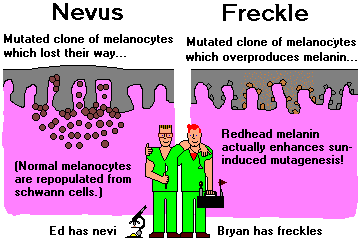
NEVOCELLULAR NEVI ("pigmented nevi", "melanocytic nevi", "moles"; single is "nevus")
Fascinating little lesions, somewhere in the borderland between hamartomas and tumors, in which masses of "nevus cells" (chemically similar to melanocytes, and sometimes making melanin) pop up at the dermal-epidermal junction and/or the upper dermis and/or elsewhere.
MELANOCYTIC NEVUS: The common, garden-variety mole (i.e., there's more to it than a lentigo.)
Most people start getting theirs as young kids, and have most of them by puberty. Apparently everybody has them; they're airbrushed out of certain photos. As we age, they tend to involute.
Nobody really knows what triggers a mole to form, but Nowell's law seems to be operating. The "West Midlands Mole Study" found more moles in whites than in non-whites, more in boys than girls, more in kids that burn rather than tan, more in frecklers, and an impressive correlation between number of moles and number of holidays in hot climates, independent of sunburn history (Arch. Derm. 128: 1201, 1992). The Vancouver study found pretty much the same thing (Arch. Derm. 126: 466 & 770, 1990). Very-light-skinned, non-redheaded kids who can tan get more nevi than those who can't tan (Arch. Derm. 145: 989, 2009.) Not surprisingly, phototherapy for neonatal hyperbilirubinemia is a strong risk factor for many nevi appearing later (Arch. Derm. 142: 1599, 2006); wheter it's a melanoma risk is unclear, but no one suggests that we abandon it.
* A current mystery of medicine is why children given chemotherapy for leukemia end up with excess melanocytic nevi, and whether these will turn to melanomas (Br. Med. J. 305: 799, 1992; Cancer 77: 1402, 1996).
JUNCTIONAL NEVI feature clumps ("nests", "* theques") of nevus cells along the dermal-epidermal junction ("JUNCTIONAL ACTIVITY"). INTRADERMAL NEVI stay distinctly below the basement membrane, while COMPOUND NEVI feature both patterns.
{09636} melanocytic nevus, gross
{09638} melanocytic nevus, gross
{12177} melanocytic nevus, gross; this was intradermal
{12194} melanocytic nevus, gross; this was compound
{12195} melanocytic nevus, gross; this was intradermal
{08150} intradermal nevus, histology
{08153} intradermal nevus, histology
{25680} junctional nevus with melanophages
{25681} junctional nevus with melanophages
{08156} nevus cells
A NEVUS SPILUS is a tight cluster of benign hyperpigmented spots, usually on an oval (long axis parallel to the dermatome), slightly hyperpigmented background. These are very common. The background has the histology of a freckle (i.e., more and overly-active melanocytes), while the dark spots have the histology of junctional or compound nevi.
{09650} nevus spilus
{09651} nevus spilus
{09653} nevus spilus
{09656} nevus spilus
|
BECKER'S NEVUS ("Becker's hypermelanosis") is a big, dark, extra-hairy (usually) patch that usually appears on a man's upper back or shoulder (occasionally elsewhere) at puberty. There are also extra arrector pili muscles, sometimes enough to make the region extra-firm. Common, and sometimes hereditary. Keep an eye on it (slight melanoma risk, just remove the melanomas in a timely way before they get dangerous -- Dermatologica 182: 77, 1991), and reassure the owner that a Becker's nevus is very macho and studly.
* Sometimes the affected region also features hypoplasia of arm and/or breast, scoliosis, lots of little skin leiomyomas, and/or spina bifida occulta (Am. J. Med. Genet. 68: 357, 1997). This is only a small minority of Becker's people, but is called "Becker's nevus syndrome." |
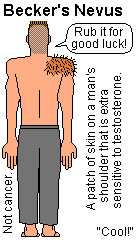
|
{09659} Becker's nevus
 Becker's Nevus Becker's NevusRichard Gere in "Breathless" |
 Becker's Nevus
Richard Gere in "An Officer and a Gentleman" |
 Becker's Nevus Becker's NevusRichard Gere in "American Gigolo" |
 Heath Ledger
What do you think? |
* Becker's nevus removal with lasers gives variable results. At least two male celebrities have had Becker's nevi disappear.
* Ota's nevus is a dark blue-brown birthmark that occurs around and sometimes on the eye. It is due to dendritic melanocytes in the dermis, at varying depths. Ito's nevus is a similar lesion on a shoulder.
BLUE NEVI are masses of darkly-pigmented, dendritic nevus-cells in the deep dermis.
The "blue" appearance (trust a dermatologist) results from viewing the pigment through dermis, just as blood appears "blue" in our veins.
The vast majority of blue nevi are benign.
* Future pathologists: Big ("cellular") ones can look nasty, but lack the anaplasia, mitoses, necrosis, and big nucleoli of a melanoma. I am not sure there is any such thing as a "malignant blue nevus", or if there is, that it should be treated differently than any other malignant melanoma -- the Sydney group (who should know) agrees (Cancer 115: 2949, 2009).
* The tumor recapitulates the pigmented cells of reptiles. There are a bunch of subtypes (Adv. Anat. Path. 16: 365, 2009).
{24902} blue nevus, trust me, this was deep-deep in the dermis.
* DEEP PENETRATING NEVUS is a fooler for melanoma except that it is confined to the deep reticular dermis and subcuteneous fat (Arch. Path. Lab. Med. 135: 321, 2011).
HALO NEVI are melanocytic nevi that are under attack by the immune system (Arch. Derm. 130: 1036, 1994). Around the nevus, you'll see local vitiligo, as the bystander melanocytes get chomped, too. Halo nevi often (not always) vanish after a while.
{09639} halo nevi, gross
{09641} halo nevus, gross
{09642} halo nevus, gross
CONGENITAL NEVI (1 kid in 4000) are often very large and impressive (J. Ped. 120 906, 1992).
Something in the spinal nerves causes this change, since these nevi follow dermatomes, and if you remove them and graft new skin, the nevus recurs.
"Malignant melanomas" often arise here. These "melanomas" are usually fairly tame, though they can kill; if you examine the cells by research techniques, many "malignant looking" melanomas prove to be benign (Am. J. Path. 136: 817, 1990).
{12204} giant congenital pigmented nevus
{24625} giant congenital pigmented nevus
A MONGOLIAN SPOT, seen in babies and toddlers, is dark pigmentation on the lower back. It fades by age 5 or so. Please don't mistake it for "an inflicted bruise so severe that it did not fade." Under the microscope, you'll see dendritic melanocytes very deep the dermis.
SPITZ NEVI are bizarre, epithelioid-and-spindle-cell nevi seen in kids. They look clinically and (to the inept pathologist) like malignant melanoma.
* Future pathologists! Confirm the diagnosis of Spitz nevus by its symmetry, its sharp demarcation, the way the cells look more benign deeper in the lesion, the absence of mitotic figures deep in the lesion, the fact that the spindle cells tend to be oriented perpendicularly, and the fact that the epithelioid cells tend to have a ground glass cytoplasm. A majority contain pink-staining globules called "Kamino bodies". There are a host of subtypes including an "atypical Spitz" that some say is malignant; the folks at Ann Arbor dispute this, but it's white knuckles (Cancer 115: 631, 2009). Nowadays, we send all the tough calls for chromosome studies (most melanomas are aneuploid; Arch. Derm. 147: 227, 2011).
Immunostains help but aren't definitive: Am. J. Clin. Path. 133: 370, 2010.
* Help: Kids without big-time predisposing anatomic or genetic birth defects almost never get malignant melanomas.
{24903} hairy nevus, congenital
{24904} hairy nevus, congenital
{25108} compound nevus, histology
DYSPLASTIC NEVI ("BK moles", etc.; Clin. Lab. Med. 31: 255, 2011)
"Premalignant moles." The dysplastic nevus tends to turn into a (usually superficial-spreading) melanoma, and a person who has had a dysplastic nevus tends to develop malignant melanomas de novo as well. Read all about it in Arch. Derm. 127: 995, 1991; Arch. Derm. 130: 993, 1994.
The typical dysplastic nevus is >4 mm across, flat or slightly raised (often areas of both), with a variegated (multicolored) appearance, and irregular borders. Look at the lesion when lit edgewise, and if the normal skin lines are distorted, that's another reason to worry (Cancer 67: 3157, 1991; nice review of the whole entity). They can occur on both sun-exposed and non-sun-exposed skin.
The typical dysplastic nevus patient suffers from a mutation in one of the melanoma genes. The reported gene on chromosome 1 (originally called CMM1) remains unidentified. Another gene on chromosome 16 is CDKN2A, a cycle regulator antioncogene; the most troublesome allele is called p16-leiden (Arch. Derm. 143: 525, 2007). See Cancer 86(S11):2464, 1999; Cancer 94: 84, 2002. Less common is an inherited oncogene, mutant CDK4 (Cancer 94: 3192, 2002).
These patients need to have either the dermatologist or their partner (now standard: J. Amer. Acad. Derm. 58: 755, 2008) keep tabs on all their nevi, and have the nasty-looking ones off. This is excellent protection against dying of melanoma (Cancer 63: 386, 1989). Nobody's more than 50% accurate in telling which pigmented lesion is going to turn out to be nasty (Br. Med. J. 299: 16, 1989), and some will fool everybody (JAMA 266: 3463, 1991).
Leave the histopathology of dysplastic nevi to pathologists. We look for atypical cells singly and/or in clumps at the dermal-epidermal junction, doing various things a normal junctional nevus won't. Another tip is elongation and fusion of the rete pegs. Yet another is layered fibrosis in the upper dermis near the lesion ("shoulders"). The intradermal component is usually slim, while the junctional component is prominent.
Some "dysplastic nevi" are much nastier than others histologically. Nowadays, you should expect your pathologist to tell you, "Should we wide-excise this particular dysplastic nevus, or merely tell the patient that he/she has had a dysplastic nevus?"
{12196} dysplastic nevus
{12197} dysplastic nevus
{09663} dysplastic nevus
MALIGNANT MELANOMA ("malignant mole", "black mole cancer"): Am. Fam. Phys. 63: 1359, 2001; Surg. Clin. N.A. 83: 77, 2003; melanoma atlas Cancer 94: 3192, 2002; Lancet 365: 687, 2005; Mayo Clin. Proc. 82: 364, 2007; CA 60: 301, 2010; Am. Fam. Phys. 85: 161, 2012.
Future rural primary care physicians! Save lives at little cost by setting up a screen-you-for-skin-cancer booth! J. Fam. Pract. 40: 471, 1995. Early identification of lesions is extremely important -- and it's no surprise that being married correlates very strongly with an earlier diagnosis (Cancer 117: 1984, 2011).
Cancer of melanocytes / nevus cells. The known independent risk factors are
(1) light complexion / freckler;
(2) sun exposure (that long-ago bad sunburn as a kid or teen is the greatest risk);
(3) dysplastic nevus syndrome (all other things being equal, your risk is 7x the next person's: Arch. Derm 127: 995, 1991);
(4) total number of benign pigmented nevi >2 mm diameter (5-10 mm, etc., rules vary; see Cancer 66: 387, 1990);
(5) xeroderma pigmentosum, etc.;
(6) having ever had a really bad (blistering) sunburn.
* (7) a few other familial syndromes, notably CDKN2 antioncogene deletion syndrome (NEJM 333: 970 & 975, 1995).
* Being treated for, say, rheumatoid arthritis with anti-TNF agents. About a 50% increase for invasive melanoma -- something with the immune system. See BMJ 346: f1939, 2013.
* Being immunosuppressed for whatever reason. Maybe. Or maybe the melanomas are just more aggressive. Mayo Clin. Proc. 87: 991, 2012.
Having said this, it's important to note that even darkly-pigmented African-American folks can and do get melanoma. Because of the idea that this is primarily a disease of the light-skinned, these people's melanomas tend to be overlooked, and mortality is much higher (Arch. Int. Med. 166: 1907, 2006; Arch. Derm. 142: 704, 2006).
The frequency of melanomas has increased 500% since the beginning of the 20th century, because people suntan rather than wear cover-up clothes. (In 1900 it was considered grossly indecent for a man to swim bare-chested at the beach.)
* A silly flap about sunscreens CAUSING malignant melanoma turned out to be unfounded (Am. J. Pub. Health 92: 1173, 2002); in fact, no relationship was found (i.e., few people use sunscreen faithfully, especially not small children).
* Your lecturer believes that the finding of a relationship between phosphodiesterase inhibitors for erectile dysfunction and melanoma (no dose-effect relationship) simply reflects the common-sense ideas that older outdoors-type / shirts-off guys are more likely to have a romantic partner (JAMA 313: 2449, 2015). Go figure.
Melanoma is rampant in Australia, where beach-going is very popular. In Queensland, 1 out of every 19 men over age 50 gets melanoma (Mayo Clin. Proc. 82: 364, 2007).
Melanoma is notorious for multiple primaries, especially (but not only) in melanoma families (JAMA 294: 1647, 2005).
The genetics of melanoma transformation is now being worked out (Nat. Rev. Cancer 3: 559, 2003). We have already mentioned the melanoma family genes. A major player is the tyrosine kinase BRAF, especially in non-sunlight-related cancers; there's a trademark mutation (Nature 417: 949, 2002; Lancet 363: 728, 2004); it's now in use to help diagnose difficult lesions (Arch. Path. Lab. Med. 131: 1361, 2007), and a particular BRAF mutaton is the target for vemurafenib, a new experimental medicine that seems to work well (NEJM 363: 809, 2010; Ann. Int. Med. 153: 587, 2010; dabrafenib Lancet 379: 1893, 2012 -- giving these people the MEK inhibitor trametinib NEJM 367: 107, 2012). Other BRAF mutations are known and seem to be responding well: J. Clin. Path. 66: 441, 2013. Strangely, somehow BRAF inhibitors seem to make antitumor immunity kick in -- J. Clin. Inv. 123: 1371, 2013. Some melanomas harbor activated or amplified KIT, and these respond for a while to imatinib (JAMA 305: 2327, 2011. Even more encouraging: inhibiting both BRAF and MEK, in the hopes that resistance will not develop (NEJM Sept 29, 2012).
* Modifying the immune response does seem to help melanoma. For example, the immune enhancer ipilimumab (targets a molecule that slows down cytotoxic T-lymphocytes) with or without nivolumab (T-cell apoptosis trigger inhibitor) enhance good-quality survival in metastatic melanoma (NEJM 372: 2006, 2015; nivolumab alone NEJM 372: 320, 2015.
You'll need to spot malignant melanomas. Look for irregular borders and variegated pigmentation (Nowell's law of genetic instability; remember that any little black dot in a brown nevus can be melanoma: Arch. Derm. 130: 1013, 1994). Of course, rapid growth and bleeding are signs, too.
Diagnosis and treatment of melanoma: Br. Med. J. 310: 492, 1995; Hosp. Pract. 29(6): 37, 15, 1994, and 29(7): 29, July 15, 1994 (great color pictures, look at them); Am. Fam. Phys. 49: 91, 1994 (more nice pictures).
* By the time you are in your primary care practice, it will probably be routine to send digital images of worrisome pigmented lesions to your three favorite dermatologists for their immediate recomendations about biopsy/excision (Arch. Derm. 140: 525, 2004; update J. Am. Acad. Derm. 59: 260, 2008; "teledermatology" Arch. Derm. 147: 556, 2011). Today, "dermoscopy" is a technique used by dermatologists to examine likely melanomas before excision; the correlation with histopathology is best when the lesion is superficial (i.e., a superficial spreading melanoma): Arch. Derm. 144: 1120 & 1311, 2008; it's also somewhat helpful in suspected amelanotic melanoma (Arch. Derm. 144: 1120, 2008). There's even a computer-assisted dermoscopy... Arch. Derm. 144: 476, 2008.
The tumor cells are usually polyhedral but may be spindle-shaped (some TOUGH diagnoses -- J. Cln. Path. 63: 296 & 391, 2010), ballooned, or dendritic, or look like oat cells, hemangiopericytoma, signet rings (Am. J. Clin. Path. 93: 731, 1990). Many melanomas, but by no means all, make melanin.
Telling melanomas from benign pigmented skin lesions under the microscope is a task best left to pathologists, unless the diagnosis is obvious. None of these are absolutely diagnostic (J. Clin. Path. 58: 409, 2005), but we look for:
Big nucleoli are usual; future pathologists can stain with S100 (stiill the most sensitive) and/or HMB-45 (very specific for malignancy in a pigmented skin lesion) (melanoma antigen, pretty specific in skin though not elsewhere: Am. J. Ophth. 109: 696 1990) or S-100 immunoperoxidase stains. Another is MART-1/Melan-A/MLANA (also very specific), which interestingly is recognized by T-cells (Cancer 87: 37, 1999). Melanomas are usually keratin negative and vimentin positive.
* Future pathologists: Many melanomas show signs of regression, with areas of intense inflammmation and areas of fibrosis without tumor. These probably correspond respectively to the red and the white areas that are often seen in melanoma. Immunostaining reveals the types of lymphocytes involved: Am. J. Clin. Path. 124: 37, 2005.
* Future pathologists: "Nuclear pseudoinclusions" are a tipoff for melanoma, and you may perform DOPA stain for tyrosinase on fresh-frozen sections of melanoma (turns them brown).
Nowadays, when there's any doubt, get genetic studies. Today's genomic microarray: Arch. Path. Lab. Med. 136: 947, 2013.
Not just for future pathologists... The most common reason for a pathologist to get sued is undercalling a melanoma (Arch. Path. Lab. Med. 130: 617, 2006). Here are the ten most-hated melanomas, i.e., the ones that the pathologist is likely not to diagnose correctly, with a resulting high-value malpractice action (Am. J. Surg. Path. 27: 1278, 2005):
The non-melanomas that are easy to miscall melanoma on microscopy include Bowen's disease, Paget's of the skin, and a dark seborrheic keratosis. J. Clin. Path. 62: 120 & 290, 2009.
Most melanomas stay confined for a while to the epidermis and uppermost dermis ("in situ", "radial growth phase"). Later (Nowell's law), they begin to invade deeper ("vertical growth phase"). Prognosis mostly depends on depth; the more lymphocytes seen "fighting" the tumor, the better the prognosis.
* Today patients with level 4 or ulcerated melanomas are likely to have a sentinel lymph node biopsied for staging, and to receive interferon alfa-2b therapy if the node is positive or the tumor is thicker than 4 mm. To find the sentinel node, inject carbon dye first: Cancer 92: 535, 2001. Consensus conference Arch. Derm. 137: 1217, 2001; since then, whether this is really saving any lives seems dubious, but patients do like knowing their status for prognosis (J. Clin. Path. 61: 897, 2008).
* Pegylated alfa-2b seems to be the best so far for adjuvant therapy for melanoma: Lancet 372: 117, 2008 (i.e., it seems to actually help).
Pathologists still distinguish different types of melanomas based on their appearance in the radial growth phase:
LENTIGO MALIGNA ("Hutchinson's freckle") is a lentigo composed of atypical melanocytes. The epidermis is not much thickened. Stays in situ for years. Huge review Arch. Path. Lab. Med. 135: 838, 2011.
* An alternative to removing a large portion of the patient's face may be topical imiquimod ("Aldera"), the immunostimulant (Arch. Derm. 141: 510, 2005). It's also useful for venereal warts and molluscum as well as basal cell carcinomas and some other not-so-aggressive skin cancers.
|
Malignant Melanoma Australian Pathology Museum High-tech gross photos
|
|
|
SUPERFICIAL SPREADING MELANOMA is a junctional nevus-like lesion composed of atypical melanocytes. Stays in situ only for months.
ACRAL-LENTIGINOUS MELANOMA is a variant that usually occurs on the palms, soles, or black-white junction of a darkly-pigmented person's hands and feet. The epidermis is thick and there is usually some atypia. These lesions are very common in black folks especially in the tropics. Extremely treacherous -- "benign or malignant" in these lesions is one of the toughest calls in pathology (Arch. Path. Lab. Med. 135: 847, 2011). Update Arch. Derm. 145: 427, 2009.
NODULAR MELANOMA begins its vertical growth phase without an obvious in situ phase.
* The old "progression" of malignant melanoma, described in "Big Robbins":
1: A normal-appearing junctional nevus
2: "Lentigenous hyperplasia", i.e., extra melanocytes as singles between the junctional clumps
3: Atypical melanocytes
4: Cells entering the superficial dermis
5: Cells going down deeper into the dermis. This can now metastasize. "We have now begun the vertical growth phase."
6: In the fat or lymphatics or has metastasized.
* The older "Clark's levels" for a melanoma:
Level I: In the epidermis and junction only (radial growth phase): 100% disease-free in 5 years
Level II: In the papillary dermis, but does not fill it, and does not reach reticular dermis; 90% disease-free in 5 years
Level III: Fills the papillary dermis, but does not actually invade reticular dermis: 70% disease-free in 5 years
Level IV: Invades reticular dermis: 40% disease-free in 5 years
Level V: In the subcutaneous tissue: 25% disease-free in 5 years
The newer Breslow's system prognosticates a melanoma based on its thickness. Under 0.76 mm is unlikely to have metastasized, etc. For more of this stuff, see Cancer 79: 2324, 1994; it is superior to Clark's level for prognosticating, though both are good (Cancer 91: 983, 2001). Works for oral melanomas too: J. Oral Max. Surg. 67: 1409, 2009.
* An independent, additional histologic factor conferring a bad prognosis is vascular invasion (tumor cells just under the endothelium is bad, tumor cells actually in lumens is worse; Arch. Derm. 137: 1169, 2001).
* A new claim is that expression of melanoma cell adhesion molecule (MCAM) on a melanoma is a more reliable indicator of bad prognosis than any other: Plast. Recon. Surg. 115: 367, 2005.
* Future pathologists: Little benign nevi are common on the capsules of lymph nodes. Don't call these melanoma. Treacherous.
* There are around two dozen histopathological variants of malignant melanoma, including one that makes bone. These are reviewed in Mayo Clin. Proc. 82: 364, 2007.
{09683} melanoma, gross
{09684} melanoma, gross
{09687} melanoma, gross
{09689} melanoma, gross
{09690} melanoma, gross
{09692} melanoma, gross
{09695} melanoma, gross
{09098} melanoma, gross, amelanotic (i.e., this one makes no melanin)
{09099} melanoma, gross, amelanotic
{24916} melanoma, gross
{24741} superficial spreading melanoma, vertical growth phase
{10940} superficial spreading melanoma, gross
{12198} superficial spreading melanoma, gross
{24914} superficial spreading melanoma, vertical
{24915} superficial spreading melanoma, vertical growth phase
{25601} superficial spreading melanoma
{12199} nodular melanoma
{25516} nodular melanoma
{25600} nodular melanoma
{24911} spindle cell melanoma
{12200} lentigo maligna
{24912} lentigo maligna
{24913} lentigo maligna
{13121} lentigo maligna
{13122} melanoma
{13123} melanoma
{13306} melanoma
{13307} melanoma
{13308} melanoma
{15400} melanoma, electron micrograph showing melanosomes
{13309} superficial spreading melanoma
{13310} superficial spreading melanoma
{12201} acral lentigenous melanoma
{08967} invasive malignant melanoma
{08968} invasive malignant melanoma
{08969} invasive malignant melanoma
{10546} melanoma, metastatic in liver
{08035} melanoma, metastatic in heart
|
|
|
|
|
Clinically, malignant melanoma is notoriously capricious. The majority are now cured surgically, but if the lesion is deep, there's the possibility of late appearance of metastases.
People under proper surveillance for melanoma are very unlikely to die of melanoma (Ann. Surg. 213: 308, 1991).
As we've seen, melanoma is the only common cancer that often expresses a "cancer-only" antigen. Probably this is why the immune system sometimes seems to cure this cancer (Cancer 69: 1377, 1992). We are starting to see clear positive results with immunotherapy (the "melanoma gp100 vaccine" with interleukin-2 seems to stop the cancer briefly until it evolves resistance, giving patients an average of six more good months (NEJM 364: 2119, 2011).
NEVUS SEBACEUS ("nevus sebaceous") is a common, often large congenital hamartoma (skin, hair, big sebaceous glands, apocrine glands), usually on the hairline on the temple. It looks like skin, but with a bumpy surface and often less hair than usual. There are syndromes with very large lesions. There is much controversy about the rate of malignancy, but the tendency nowadays is to excise them.
SEBORRHEIC KERATOSIS (* "basal cell papillomas", * "barnacles")
A badly-named local hyperplasia of the basal cells. Typically the lesions produce small masses of keratin ("horn cysts") that resemble the pearls of squamous cell carcinoma but show no malignant features.
The lesions usually are pigmented (remember basal cells take up melanin), usually are crusty (i.e., horn cysts), and can be scraped off with a butter knife (only to grow back).
* DERMATOSIS PAPULOSA NIGRA is the only name I've ever been able to find for the multiple black facial spots seen on many people of African ancestry (Sidney Poitier, Morgan Freeman and Bill Cosby have them), and occasionally on East Asian folks as well. They are a non-problem; the histology is similar to seborrheic keratosis.
Microscopically, look for a flat-bottomed hyperplastic mass of benign basal cells, with the "horn cysts" or at lesat a lot of loose keratin. Especially if the patient picks at them ("irritated SK"), the "keratin pearls" may fool you into thinking this is a squamous or basosquamous carcinoma.
Future primary care physicians: If many seborrheic keratoses erupt at the same time, it could be "the sign of Leser-Trelat", herald of a visceral adenocarcinoma. Don't miss this one.
* Not standard yet, but for annoying "SK"'s, think about a trial of 1,25-dihydroxy vitaminD3, as for psoriasis. A rumor yesterday, it's now pretty much standard (J. Derm. 32: 420, 2005).
{12502} seborrheic keratosis
{12765} seborrheic keratosis
{25496} seborrheic keratosis
{24895} seborrheic keratosis, histology
{24896} seborrheic keratosis, histology
{12771} seborrheic keratoses, think of Leser-Trelat
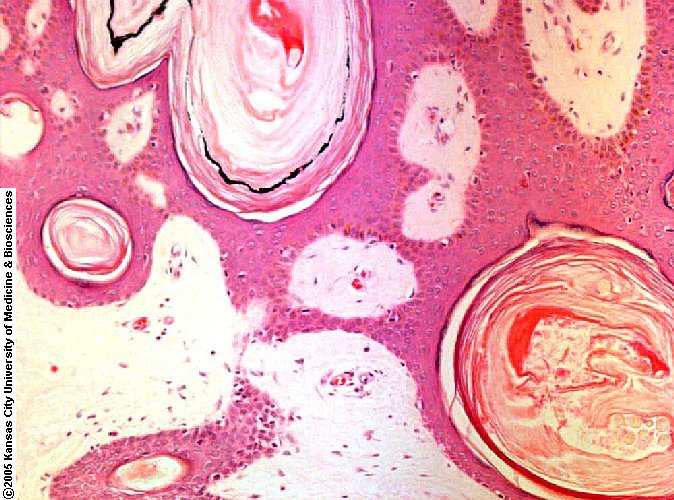 Seborrheic keratosis
Horn cysts
ERF/KCUMB
ACANTHOSIS NIGRICANS
This is seborrheic keratosis-style hyperplasia covering each armpit and/or the groin. Again, this may herald a visceral malignancy, or be seen in some insulin-resistance syndromes, or simply result from administration of nicotinamide.
* Some wag gave the name of "terra firma forme dermatosis" ("dirty keratin") to the curious brown lesions that form on the backs of the necks of some children. The pigment cannot be removed with soap, but comes off easily with rubbing alcohol. Quite common.
{25607} acanthosis nigricans
{25608} acanthosis nigricans
FIBROEPITHELIAL POLYPS ("acrochordons", "skin tags", "squamous papillomas", etc., etc.)
Mysterious little bumps of soft fibrous tissue covered with epidermis that may be slightly thick and/or slightly pigmented.
These pop up most anywhere in older people; the favorite spot is the neck. Savvy patients may be concerned that their acrochordons are melanomas. The most savvy patients know they aren't, and cut them off with nail clippers. Doctors tie the base off with a thread.
{12176} acrochordon
{12780} acrochordons
{12781} acrochordons
{12206} brown skin tag
Squamous Cell Papilloma
Ignore the text -- this one
is not an HPV-related lesion
ANGIOKERATOMAS are hemangiomas with an overlying hyperkeratotic epidermis. Some men gets these all over their scrotums as they grow older; patients with Fabry's disease (Arch. Derm 140: 1440, 2004) often have many spread all over the body.
{25116} Fabry's
EPITHELIAL CYSTS ("epidermoid inclusion cysts"; "wens"; "sebaceous cysts")
These familiar bumps are spheres of epithelium turned inside-out. Skin products (sebum, keratin, or both) accumulate, causing the mass to grow and grow.
Probably the epidermoid and pilar (trichilemmal) cysts result from bits of epidermis getting pushed deep into a person (it's a picturesque, rare, but serious complication of lumbar puncture).
* Ron Hubbard, founder of "Scientology", was obviously bothered by his epidermoid cyst toward the end of his life. One of his prominent followers observed this, and that's how she finally realized that Hubbard did not possess miraculous powers after all. Anecdote from the biography by Hubbard's son.
When one of them ruptures (i.e., you really squeezed it good), there's often an impressive inflammatory response, with foreign body giant cells prominent after it settles down.
{12170} epidermoid inclusion cyst, shoulder
{10310} epidermoid inclusion cyst
{12504} epidermoid inclusion cyst
More about these cysts:
Epidermoid inclusion cyst: The epithelium is garden-variety stratified squamous epithelium, and the junk in the center is layer-upon-layer of keratin.
Pilar / tricholemmal cyst: The epithelium is more like pilosebaceous apparatus, with no granular layer, and the junk in the center is a mix of keratin and sebum.
Dermoid cyst: Uncommon in the skin; the epithelium really is skin, and the junk in the center is a mix of keratin, sebum, and real hair. Most often these occur at the lateral canthus of the eye. These may result from tiny birth defects.
MILIA are little epidermoid inclusion cysts that are usually multiple, arising in groups de novo or at sites of healed disease or injury. (Singular is milium.) Some physicians remove them simply by incising with a scalpel blade tip and expressing the contents with a comedone extractor. (I have used a scalpel-and-paperclip technique on myself. No anesthesia is required.)
STEATOCYSTOMA MULTIPLEX: Many sebaceous cysts, either in a localized area or all over the skin. There is an autosomal dominant form (Plast. Recon. Surg. 99: 1142, 1997), and probably the sporadic localized lesions that you'll see on individuals result from localized mutations. Surgery is best done by someone experienced with plastics, and if the patient comes in often, it can be kept under good control.
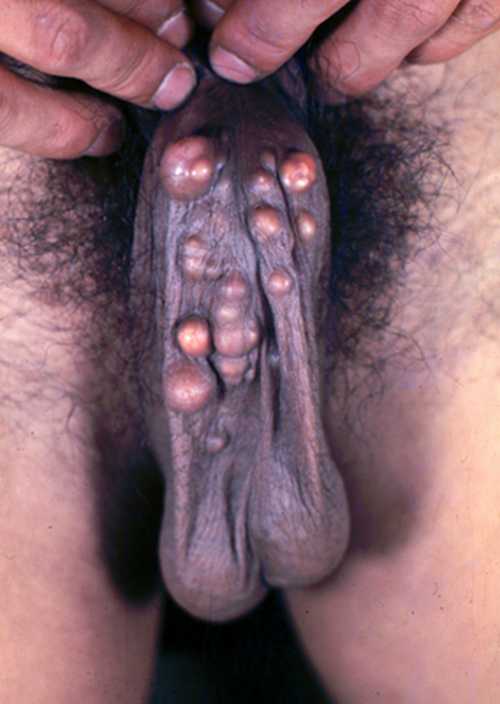 Steatocystoma multiplex
Scrotum
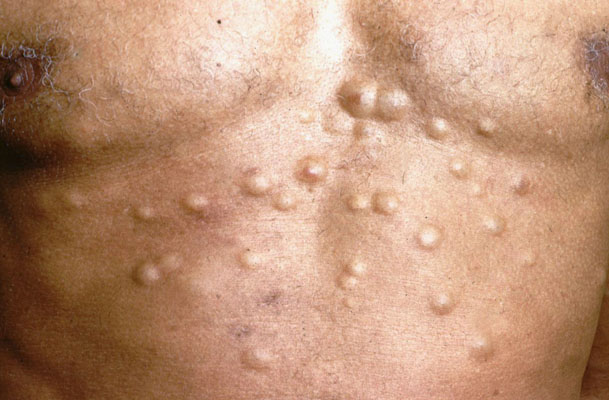 Steatocystoma multiplex
Prize photograph
Institute of Medical Illustrators
Pilonidal cyst is a misnomer (should be "pilonidal sinus") for a deeply-imbedded, chronically infected mass of hair originally trapped in a little dimple over the sacrum. Most patients are young hairy men. It's very common and very unpleasant.
* HIAWATHA'S MITTENS
He killed the noble Mudjokivis [beaver],
Of the skin he made him mittens,
Made them with the fur side inside,
Made them with the skin side outside,
He, to get the warm side inside,
Put the inside skin side outside;
He, to get the cold side outside,
Put the warm side fur side inside.
That's why he put the fur side inside,
Why he put the skin side outside,
Then he turned them inside outside.
--Parody of Longfellow
KERATOACANTHOMA
A bizarre, hideous-looking, volcano-shaped, often self-curing lesion of epidermis (usually the face or upper extremities) that erupts over a week or two and produces a large (up to several cm), cone-shaped lesion with a dense keratin plug in its "crater".
Patients will be scared that they have cancer. However, there's little or no cytologic atypia. The good thing about this lesion is that it often goes away by itself in a few weeks or months. Puzzle that out (virus, betcha)!
It is hard to tell the lesion from a squamous cell carcinoma histologically.
* Older studies indicate that keratoacanthomas stain for filaggrin while squamous carcinomas do not. The antibody is not in common use.
To complicate matters, squamous cell carcinoma is now known to be a frequent complication, and nowadays dermatopathologists are starting to call these "squamous cell carcinoma, keratoacanthoma type", indicating a high likelihood of spontaneous regression.
Your lecturer believes that a lesion that is clinically a keratoacanthoma should probably come off, because (1) there is a high risk that it's cancer, and (2) there is usually a nasty scar even if it regresses. Not everybody agrees. Consider consultation.
* When the BRAF inhibitor vemurafenib is given for melanoma, some patients erupt with dozens of little keratoacanthomas and/or squamous cell carcinomas (Arch. Derm. 148: 363, 2012). The molecular mechanisms are under study; somehow the medicine takes the brakes off latent squamous skin lesions (NEJM 366: 207, 2012).
{12792} keratoacanthoma
{12795} keratoacanthoma
{12799} keratoacanthoma
{24892} keratoacanthoma, histology
{24893} keratoacanthoma, histology
|
|
SKIN ADNEXAL TUMORS ("appendage tumors"): A bewildering family of minor skin tumors.
Cylindroma: A benign tumor of sweat glands, usually on forehead or scalp, often multiple (* CYLD, Nat. Genet. 25: 160, 2000).
{25595} cylindromas ("turban tumor")
{25596} cylindromas
Syringoma: A benign tumor of sweat glands, usually appearing in groups on and around the lower eyelids. Benign sweat glands appear surrounded by a dense collagenous stroma.
Today, they're typically removed using lasers.
Multiple synchronous "tumors" suggests a viral infection rather than a true neoplasm, but the familial syndrome suggests we actually are dealing with neoplasia. Probably a circulating growth factor awaits discovery.
{10307} syringoma
* Leave the diagnosis of curious lesions like the "eccrine poroma" of the palms and soles, and the very painful "eccrine spiradenoma", to us.
Trichoepithelioma: A benign tumor that makes little hair follicles.
* There is an anti-oncogene deletion syndrome with trichoepitheliomas and cylindromas. This can be quite a problem for a plastic surgeon.
{11767} trichoepithelioma
{11788} trichofolliculoma
Trichilemmoma: A benign tumor "arising from a different layer of the hair follicle"; a little white hair may arise from its center
{11806} trichilemmoma
* Cystic sebaceous tumors are diagnostic of Muir-Torre (Arch. Path. Lab. Med. 127: 614, 2003), an allele at a HNPCC Lynch locus.
Others too numerous and insignificant to merit your attention.
{24888} hidradenoma
{24889} hidradenoma
* {24920} calcifying epithelioma of Malherbe ("pilomatrixoma")
ACTINIC KERATOSIS (review Am. Fam. Phys. 49: 817, 1994)
Localized squamous cell carcinoma in situ (or at least "atypia") of the epidermis. Grossly, you'll see irregular atrophy and hyperkeratosis of the epidermis. Some forget how to shed old keratinocytes altogether, and become "skin horns".
|
|
|
Independent risk factors include light skin / frecklers, sun exposure, and of course xeroderma pigmentosum, as well as arsenic exposure ("arsenical keratoses" tend to be on palms and soles).
These lesion tend, if ignored, to turn into invasive squamous cell carcinomas, but only 1 chance in 1000 that a particular actinic keratosis will turn into invasive cancer in a particular year (Cancer 75-S: 245, 1995). You may excise them, kill them with fluorouracil or injected interferon (Arch. Derm. 128: 1486, 1992; it's been used for invasive squamous cancer, too), or follow whatever is the current recommended therapy.
|
{12736} actinic keratosis
|
 Simpsons character |
BOWEN'S DISEASE: Hideously anaplastic carcinoma in situ of the epidermis, as a red plaque on sun-exposed skin, oral mucosa, or genital skin. Althogh it looks terrible, it does not penetrate the basement membrane. Again, arsenic exposure is a risk factor. The risk of invasion is 10% or less.
The old claim that Bowen's of the skin is marker for a second, internal malignancy never made sense and is discredited.
"Paget's disease of the skin" is adenocarcinoma cells in the epidermis ("the cancer cells are epidermis-trophic"). On the nipple, it's probably from an underlying breast cancer. On the perineum, its origin may be unclear, and it's a treatment challenge.
Bowen disease
Skin
Wikimedia Commons
SQUAMOUS CELL CARCINOMA (Plast. Recon. Surg. 114: 82e, 2004; molecular pathways J. Cln. Inv. 122: 464, 2012)
The familiar histologic pattern, this time invading the skin. There are about 100,000 of these in the United States yearly, and about 2500 deaths, almost all due to people ignoring them.
Independent risk factors include light skin / freckler, sun exposure,
radiation therapy,
arsenic exposure (still epidemic in some places), exposure to coal
tar (carcinogenic polycyclic compounds), xeroderma pigmentosum, the edges of chronic draining
osteomyelitis sinuses (why? Nowell's law...), longstanding pilonidal
sinuses, old burn scars (minor mystery called "Marjolin's ulcer"), and immunosuppression
for renal transplants (Lancet 346: 403, 1995.
Some of the lesions in the immunosuppressed
contain KSHV: Lancet 345: 1339, 1995).
Grossly, these are typically exophytic cancers that grow up slowly on sun-exposed skin. Squamous cell carcinomas of the skin are common but fortunately tend to be well-differentiated and seldom metastasize unless neglected.
Exactly how to manage them so that they don't recur is presently still under discussion. The Australians are recommending margins of at least 5 mm (Plast. Rec. Surg. 120: 910, 2007). For palliation when the risk of surgery is unacceptable, cetuximab (the antibody against epidermal growth factor receptor) is now in use (Arch. Derm. 143: 889, 2007).
{12735} squamous cell carcinoma
{12733} neglected squamous cell carcinoma
{21858} squamous cell carcinoma
{21859} squamous cell carcinoma of eye
{12169} squamous cell CA, lip
|
|
Squamous Cell Carcinoma
Text and photomicrographs. Nice.
Human Pathology Digital Image Gallery
 Squamous cell carcinoma
Eye pathology site
|
 The Others |
Children with xeroderma pigmentosum typically develop severe disfigurement and many tumors on exposure to ultraviolet light. These include both the usual sunlight carcinomas and some sarcomas (Arch. Path. Lab. Med. 115: 910, 1991). Death usually occurs in the teenaged years. Most versions also feature precocious death of brain cells (Brain 114: 1335, 1991). Consider it sooner rather than later when the parents say "Junior sunburns too easily" (BMJ 336: 444, 2008).
Even xeroderma pigmentosum patients can be managed as dysplastic nevus patients are -- very, very close, frequent skin inspection -- to their great benefit (Arch. Derm. 145: 920, 2009).
{25012} xeroderma pigmentosum
BASAL CELL CARCINOMA
Cancer of small, cuboidal-like cells resembling the normal basal cells of the skin. The real "histogenesis" of this tumor is probably the hair shaft, since it doesn't occur where hair doesn't grow.
Independent risk factors include light complexion / freckler, sun exposure, xeroderma pigmentosum, and the "patched" (PTCH) / Gorlin / basal cell neuvs" anti-oncogene deletion syndrome (also mutated in sporadic cases, of course: Cancer Res. 57: 2581, 1997).
* There is no such thing as a "basal cell nevus". Physicians who miss the jaw cysts and pitted palmar keratin of Gorlin's misdiagnose the kid as having "lots of moles" -- and the face becomes mutilated.
* Although sun exposure is etiologic, the most common locations are not those that receive the most sunlight, and some other factors are involved as well: Arch. Derm. 138: 1494, 2002.
Grossly, you'll see the familiar "rodent ulcer" with a "rolled, pearly border". Or you may see a telangiectatic papule, a small nodule, or a small pigmented area. Dermatologists are good at spotting these when they are still tiny.
Histologically, you'll see a low-grade cancer, with its invasive masses of cells rimmed by a picket-fence-like row of basal cells. There are subtypes. Mitotic figures and necrosis are uncommon, and these tumors almost never metastasize (one did at K.U.: Am. J. Med. Sci. 301: 395, 1991; five neglected huge ones did in Wisconsin Cancer 73: 328, 1994).
Rule: Most skin tumors on or above the lower eyelid are basal cell carcinomas. Most skin tumors below the lower eyelid are squamous cell carcinomas.
* Future pathologists: The lymphocytic infiltrate can be heavy, even simulating lymphoma.
* Future pathologists: Maybe you'll get to take part in MOH'S MICROSURGERY, where the surgeon takes the area apart one sliver at a time and you tell each time whether there's cancer on it.
* Both Gorlin's and advanced basal cell carcinomas regress when treated with vismodegib, which targets one of the genes involved (deep stuff, NEJM 366: 2171 & 2180, 2012). * Fun to follow: The first experiments using Dz13, a deoxyribozyme that targets JUN messenger RNA, injected into basal cell carcinomas shows it to be safe Lancet 381: 1835, 2013.
|
|
|
|
{12168} basal cell carcinoma, gross
{12706} basal cell carcinoma
{12711} basal cell carcinoma
{12714} basal cell carcinoma
{12723} basal cell carcinoma
{21847} basal cell carcinoma
{21850} basal cell carcinoma, histology
{21856} basal cell carcinoma, histology, sclerosing variant with desmoplasia
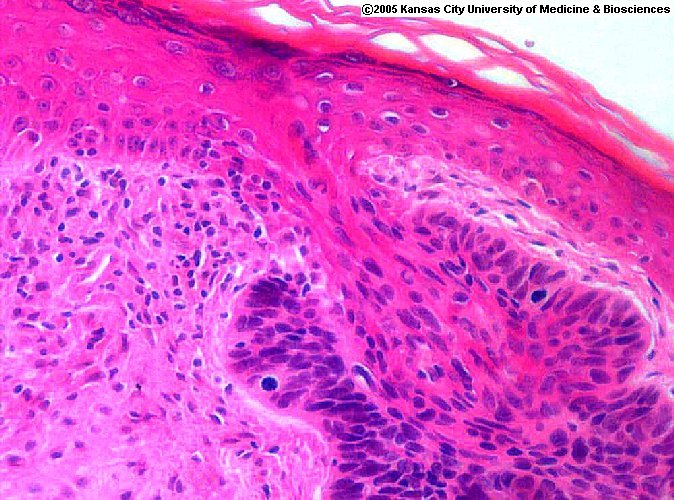 Basal cell carcinoma
Arising off a hair shaft
ERF/KCUMB
 Nevoid basal cell carcinoma syndrome
Pittsburgh Pathology Cases
MERKEL CELL CARCINOMA (neuroendocrine skin cancer; Cancer 88: 1842, 2000; Am. J. Clin. Path. 115 S: S 68, 2001; Cancer 110: 1, 2007; Cancer 113: 2549, 2008; Arch. Path. Lab. Med. 134: 1711, 2010; Barnes series Ann. Surg. 254: 465, 2011)
An uncommon, bad skin cancer that (as you would expect) looks microscopically like oat cell carcinoma of the lung. Tumors show both epithelial and APUD differentiation (like oat cell carcinoma).
* Pathologists look for neoroendocrine stains; the most sensitive for Merkel cell carcinoma is cytokeratin 20, which lights up as perinuclear dots. To distinguish it from oat cell carcinomas: Most oat cells light up with TTF-1 while most Merkel cells do not. Most Merkel cells light up with CK20; most oat cells do not.
Around half of these metastasize, and 20% will kill.
Merkel Cell Carcioma
Electron micrographs
VCU Pathology
BENIGN CUTANEOUS FIBROUS HISTIOCYTOMA ("dermatofibroma", "sclerosing hemangioma")
A quasi-tumor of macrophages (?) or fibroblasts (?) in the dermis. The cells are usually spindle-shaped and infiltrate among the dermal collagen bundles. The edges are sharply circumscribed, and the lesion does not extend quite to the top of the dermis.
* Whatever the histogenesis, there's always a mix of cells that stain as fibroblasts and cells that stain as histiocytes; nobody's found (or looked hard for) trademark genetic mutations as in a real cancer. The fact that they light up for XIIIa suggests the cell of origin may be the dermal dendrocyte.
Dermatofibromas often follows a minor injury, bug bite, or whatever.
Patients find a palpable bump somewhere, with overlying pigment. They may want it off, or just want reassurance. Trick: Pinch it. If it dimples, it's probably a dermatofibroma (why?). If it doesn't, it's probably something else.
These lesions often become pigmented with hemosiderin and to become lipid-rich (many are yellow when cut), and the overlying epidermis tends to hyper-pigment and to thicken a bit.
* Future pathologists: Basal cell hyperplasia over a dermatofibroma often mimics basal cell carcinoma microscopically.
{12203} dermatofibroma
{12772} dermatofibroma
{12774} dermatofibroma
{12775} dermatofibroma
{12777} dermatofibroma
{25593} dermatofibroma
* ERUPTIVE DERMATOFIBROMAS ("generalized eruptive histiocytoma"; Acta Derm. Ven. 82: 241, 2002) appear in dozens or even hundreds over the body. In about half of cases there underlying systemic lesion; the rest are immunocompromised for whatever reason, and at least at least two familial syndromes have been reported (Cutis 69: 187, 2002; J. Eur. Acad. Derm. 20: 90, 2006). PUVA therapy has caused regression (Abstract UI 17274780; or maybe it just went away by itself, as it's been reported to do before). It remains a minor mystery of medicine; I have yet to read of a serious complication.
ATYPICAL FIBROXANTHOMA is a dermatofibroma variant seen on sun-exposed skin (tops of the ears is a favorite site). The histology is floridly malignant; the behavior more benign. Let the pathologists worry about it.
* Dermatofibrosarcoma protuberans is a "low-grade malignant" version of the dermatofibroma, with a distinctive storiform (cartwheel, pinwheel, i.e., like ovarian stroma) pattern of its spindle cells. It tends to invade the underlying fat along the septa (dermatofibromas won't do this, even if they have a few anaplastic cells). Review, including histological criteria for nastiness: Cancer 88: 2711, 2000; also Cancer 101: 2503, 2004; J. Clin. Path. 58: 751, 2005.
XANTHOMAS ("xanth-" means "yellow", "-oma" here means "bump")
Masses of triglyceride- and/or cholesterol-laden macrophages.
If you should happen to excise one, the pathologist will see masses of foamy macrophages and often Touton giant cells (flower cells), with a ringlet of nuclei in the middle of the cell.
Here's a simplified classification:
ERUPTIVE XANTHOMAS: Pop up abruptly on the butt, knees, and elbows when triglyceride-rich lipoproteins go out of control.
TUBEROUS XANTHOMAS: Pop up on the backs of the heels and fingers when cholesterol-rich lipoproteins go out of control.
JUVENILE XANTHOGRANULOMAS: Round nodules that pop up especially on the heads and trunks of babies. Pathologists will point out the distinctive floret ("flower" / "Touton") giant cells. In children, most self-cure in a few years.
* PLANE XANTHOMAS: Pop in the lines of the palms in primary biliary cirrhosis.
XANTHELASMA: Pop up around the eyes when LDL is up, or for no known reason.
{09741} xanthomas
{09744} xanthomas
{12219} xanthoma
{24886} xanthoma
PSEUDOXANTHOMA ELASTICUM is a recessive disorder with little yellow plaques in skin folds (check armpits and groin). They are made of elastin, not lipid; under the microscope, they are often calcified. The biggest problem is angioid streaks in the retina, which tend to bleed; elastic arteries may also dilate. The gene is also a coronary risk locus: Circulation 106: 773, 2002.
{05937} pseudoxanthoma elasticum
VASCULAR LESIONS: We examined these in other sections.
{12510} cherry angiomas
{05926} spider angioma
{05928} spider angiomas
{12235} hemangioma
{12237} Kasabach-Merritt hemangioma
|
|
* Future pathologists: The key to recognizing early Kaposi's is that it's little clusters of little blood vessels sprouting directly off the big vessels. Tough call; otherwise, it looks like granulation tissue. Today, the LANA-1 stain for HHV8 reliably is positive in Kaposi's and negative in its mimics (Am. J. Clin. Path. 121: 330 & 335, 2004). Remember African Kaposi's is common in Africa, doesn't mean AIDS, and tends to spread to the lymph nodes. Virus, you know.
MYCOSIS FUNGOIDES / T-CELL LYHPMOMAS OF THE SKIN
We've already examined this entity under "White Cells". For a pathologist's review of the T-cell and NK-cell lymphomas of the skin, see Am. J. Clin. Path. 127: 670, 2007. Update on the diagnosis of mycosis fungoides: Am. J. Clin. Path. 139: 552, 2013.
* Leave the other skin lymphomas (and pseudolymphomas, among which
Lyme
disease
is notorious) to pathologists. The subject is extraordinarily
difficult (J. Clin. Path. 59: 813, 2006).
{09041} mycosis fungoides
{12754} mycosis fungoides
{12751} mycosis fungoides, tumor stage
{12757} mycosis fungoides (this was a Sezary case)
{12759} mycosis fungoides, Pautrier micro-abscess
{09042} mycosis fungoides, convoluted T-cell as seen on electron microscopy
MASTOCYTOSIS -- obscure enough to save for your clinical rotations, or the hematology section of your classroom time. Update Am. J. Clin. Path. 138: 416, 2012.
Localized or generalized hyperplasias of mast cells. There are at least five subtypes.
The familiar forms are "urticaria pigmentosa" (multiple pigmented lesions that swell when rubbed; Am. J. Clin. Path. 109: 279, 1998) and the solitary mastocytoma. ("Tickle the baby's spot and he goes into shock!").
Generalized systemic mastocytosis is more ominous, and poorly understood. Symptoms can be due to excess histamine (what would that do?), GI bleeding or epistaxis (remember mast cells make heparin), and bone lesions.
Systemic mastocytosis runs a slow course but is considered incurable; one case with mutant KIT disappeared on imatinib treatment (Blood 112: 1655, 2008). * A serum marker for mastocytosis is serum tryptase; you can also stain for it in sections.
A SAMPLER OF OTHER SKIN LESIONS
We'll talk about TB elsewhere, but if you hear the term "lupus vulgaris",
remember it's a strange name for cutaneous tuberculosis.
{08157} fifth disease
{08158} fifth disease
{08167} erythema chronicum migrans
{08170} heroin tracks
{08199} yaws, skin disease
{08200} yaws, skin disease
{08389} cutaneous larva migrans
{08393} leishmaniasis
{09734} pyoderma gangrenosum
{09737} pyoderma gangrenosum
{09738} pyoderma gangrenosum
{10067} abscess
{10081} squamous cell carcinoma, keratin pearl
{12215} amyloid of the skin
{12229} erysipelas, strep infection
{12486} squamous cell carcinoma
{12513} exfoliative erythroderma
{12523} photodermatitis
{12805} keloid
{13120} dermatomyositis, Gottron's sign
{13338} herpes, skin
{13343} leprosy
{14145} herpes zoster
{14146} herpes zoster
{14148} herpes zoster
{14200} folliculitis. ERF had this ages 11-17, probably
tinea versicolor folliculitis.
{14202} folliculitis, ditto
{24917} scleroderma, skin
{12226} granuloma annulare
{24918} granuloma annulare
{24923} blastomycosis, skin
{24933} histology of chicken pox
{53760} linear nevus sebaceus (nevus sebaceous)
|
|
|
|
|
|
|
|
* Pseudoscience: During the 1990's, an elaborate mythology about melanin (as the essence of human intelligence, a superconductor, the source of psychic powers, etc., etc.) has been promoted. There are "melanin conferences", etc. It's obvious to any real scientist or thinking physician that this is simply a crooked way to make money. Ironically, until recently, U.S. minorities were traditional victims of the same caliber of racist pseudoscience. Stay tuned, this business isn't funny.

STILL MORE SKIN STUFF:
{12189} balanitis xerotica
{12190} tuberous sclerosis ash-leaf spots
{12169} squamous cell CA, lip
{12214} necrobiosis lipoidica diabeticorum
{12226} granuloma annulare
{12227} furuncle
{12230} hidradenitis suppurativa, vulva
{5926} spider angioma
{5928} spider angioma
{12235} hemangioma
{12237} Kasabach-Merritt hemangioma
{12274} lupus, butterfly rash
{12292} measles (rubeola)
{12337} clubbing
{12305} abetalipoproteinemia, RBC's ("ET-finger cells")
{12668} nutmeg liver
{12762} Kaposi's
{12801} scar
{12807} keloid
{13053} granuloma annulare, gross
{13120} dermatomyositis, Gottron's sign
{13338} herpes, skin
{13343} leprosy
{12786} pyogenic granuloma
{12789} pyogenic granuloma
{12805} keloid
{13613} amyloid vessel, H&E
{13392} cystic hygroma
{13370} flea-bitten kidneys
{14137} varicella
{18250} phenylketonuria
{18253} phenylketonuria
{19377} melanoma of the eye
{21859} squamous cell carcinoma of eye
{24626} scleroderma, hands
{24854} hyperplastic arteriolar sclerosis in scleroderma
{24917} scleroderma, skin
{24918} granuloma annulare
{24923} blastomycosis, skin
{24933} histology of chicken pox
{25116} Fabry's
{25024} fatty streaks
{25675} lupus, butterfly rash


* SLICE OF LIFE REVIEW
11760
skin, normal
11761
skin, normal
14788
skin, thick
14789
skin, thick
14790
melanin in the skin, normal
14791
melanin in the skin, normal
14792
skin, thick
14793
skin, thick
14794
skin, thick
14795
skin, thick
14796
sebaceous gland, normal
14797
sebaceous gland, normal
14798
dermal papilla, normal
14799
dermal papilla, norma
14800
meissner's corpuscle
14801
meissner's corpuscle
15092
skin, normal
15093
skin, normal
15305
skin, thin
15306
skin, thin
15307
skin, thin
15308
skin, thin
15309
skin, thin
15310
skin, thin
15311
skin, thin
15313
skin, thick
15315
skin, stratum corneum and lucida
20914
skin
20916
skin, eccrine gland
20917
sebaceous gland, skin
20918
skin, thick
20919
skin, thick
20920
skin, thick
20921
skin, thick
20922
pacinian corpuscle, skin
20923
skin, thick
24860
skin, normal
25083
skin, normal
25084
skin, normal epidermis
Ed's Autopsy Page
The Pathology Blues
 Ed's Pathology Review for USMLE I
BIBLIOGRAPHY / FURTHER READING
I urge anyone interested in learning more about skin pathology to consult these standard textbooks.
In my notes, the most helpful current journal references are embedded in the text. Students using these during lecture strongly prefer this. And because the site is constantly being updated, numbered endnotes would be unmanageable. What's available online, and for whom, is always changing. Most public libraries will be happy to help you get an article that you need. Good luck on your own searches, and again, if there is any way in which I can help you, please contact me at scalpel_blade@yahoo.com. Health and friendship!


| New visitors to www.pathguy.com reset Jan. 30, 2005: |
 Drop by
and meet Ed Drop by
and meet Ed
|

|
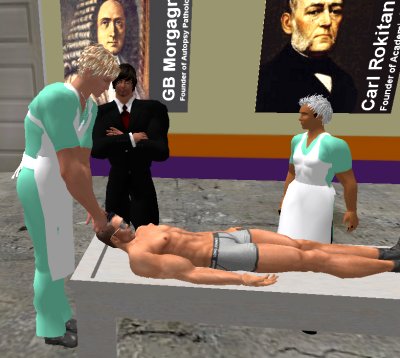
| If you have a Second Life account, please visit my teammates and me at the Medical Examiner's office. |
Teaching Pathology


 | Pathological Chess |
 |
Taser Video 83.4 MB 7:26 min |
 |
Click here to
see the author prove you can have fun skydiving without being world-class. Click here to see the author's friend, Dr. Ken Savage, do it right. |


 Skin / Eye (?!)
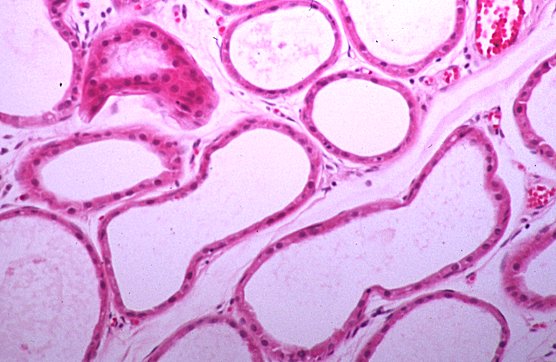 Apocrine glands
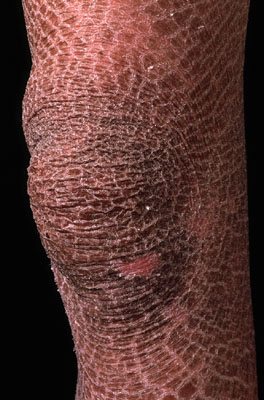 Common ichthyosis
 Ichthyosis "Collodion baby"
 Harlequin ichthyosis
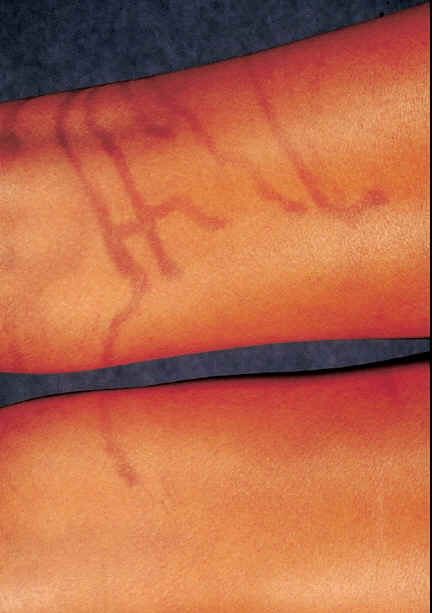 Phytodermatitis from a lime on a cocktail
 Comedone nevus
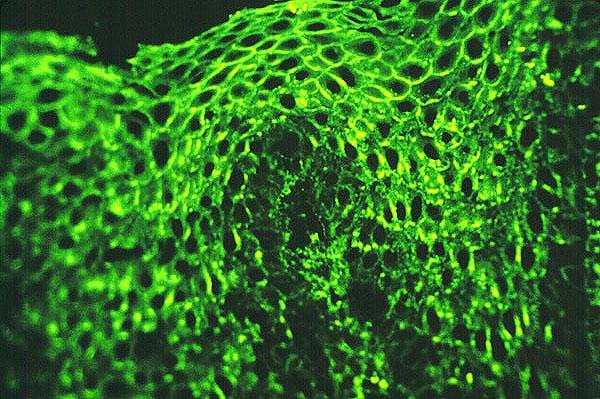 Pemphigus
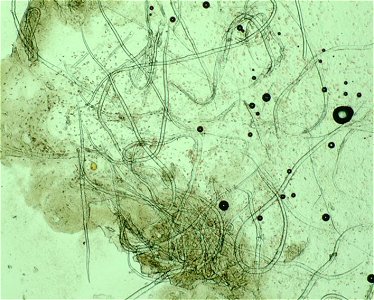 Pityrosporum, KOH prep
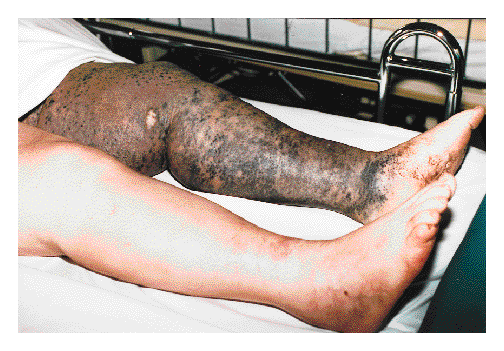 Melanoma metastases
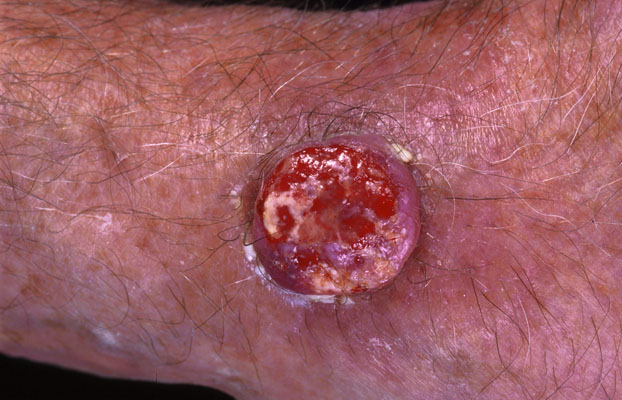 Keratoacanthoma
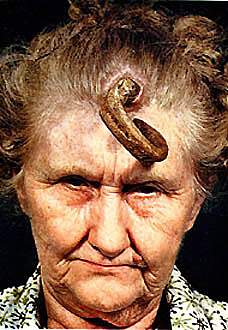 Skin horn
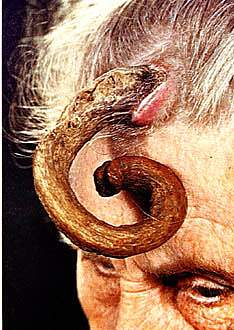 Skin horn
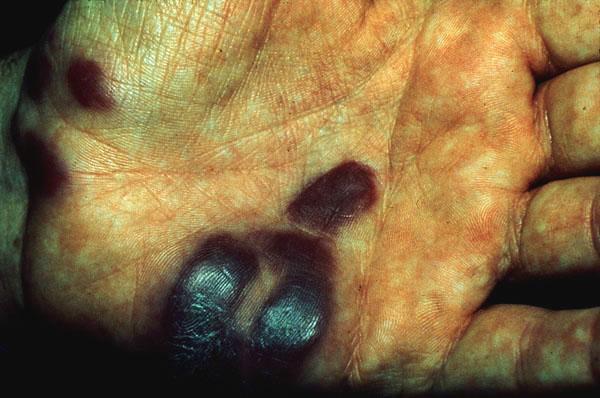 Kaposi's sarcoma